挨 (āi/ái) means "suffer; be next to" in Chinese. It has 10 strokes with the radical 扌, and is HSK Level 6.
Rated 4.2/5 in difficulty (advanced).
Harder than 63% of HSK Level 6 characters.
Appears in 4+ common words including 挨近 (āi jìn), 挨个 (āi gè), 挨打 (ái dǎ).
Due to its 10 strokes, Hanzi Writer's error detection shows 挨 requires focused practice — most learners need 10+ attempts for consistent accuracy.
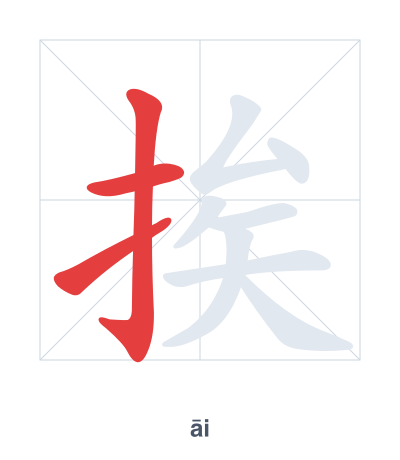
Open Hanzi Writer to see the animated stroke order and practice writing 挨 with real-time feedback.
The character 挨 (āi/ái) is written with 10 strokes. Follow the standard Chinese stroke order: top to bottom, left to right, outside before inside. The radical 扌 is one of its key components.
Practice the correct stroke order with the Hanzi Writer app to see animated stroke-by-stroke guidance with real-time feedback.
挨 means suffer; be next to.
This is a polyphonic character with readings: āi, ái.
As an HSK Level 6 character, 挨 is an intermediate-level character.
The character 挨 combines the hand radical 扌 (action) with 矣 (yǐ, originally meaning 'to stop' but used phonetically). The hand suggests physical contact: being struck (suffer) or being placed adjacent (be next to). Historically, 矣 also depicts a person exhaling, reinforcing the sense of enduring something.
💡 Memory Tip: Picture a hand (扌) shoving a person with a big hat (矣) — the person suffers the shove and ends up standing right next to the shover.
那个孩子慢慢向母亲挨近。
nà ge hái zi màn màn xiàng mǔ qīn āi jìn
The child slowly moved closer to his mother.
老师挨个检查大家的作业。
lǎo shī āi gè jiǎn chá dà jiā de zuò yè
The teacher checked everyone's homework one by one.
犯了错误要勇于承认,不要等挨打。
fàn le cuò wù yào yǒng yú chéng rèn bú yào děng ái dǎ
When you make a mistake, have the courage to admit it; don't wait to be punished.
这里的难民正忍受着挨饿的痛苦。
zhè lǐ de nàn mín zhèng rěn shòu zhe ái è de tòng kǔ
The refugees here are suffering from the pain of hunger.
Open Hanzi Writer to see the animated stroke order and practice writing 挨 with real-time feedback.
✨ Animated stroke order · Handwriting recognition · HSK-graded practice · Free to use
挨 combines the hand radical 扌 on the left with 矣 (yǐ) on the right. The right part suggests completion or a state, and together with the hand radical it originally meant "to push against" — leading to both "to be next to" and "to endure" (as in suffering a blow). So the hand radical shows an action, while 矣 adds the idea of a resulting condition.