逼 (bī) means "to force; to compel" in Chinese. It has 12 strokes with the radical 辶, and is HSK Level 6.
Rated 4.2/5 in difficulty (advanced).
Harder than 94% of HSK Level 6 characters.
Appears in 3+ common words including 逼近 (bī jìn), 强逼 (qiǎng bī), 逼真 (bī zhēn).
Due to its 12 strokes, Hanzi Writer's error detection shows 逼 requires focused practice — most learners need 10+ attempts for consistent accuracy.
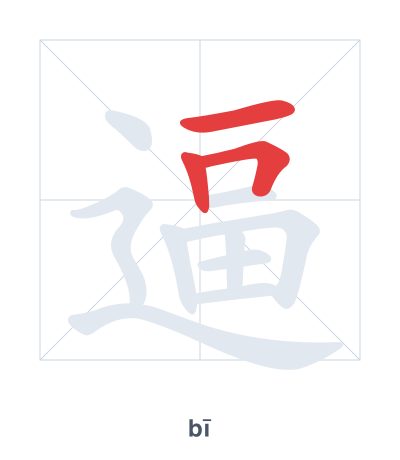
Open Hanzi Writer to see the animated stroke order and practice writing 逼 with real-time feedback.
The character 逼 (bī) is written with 12 strokes. Follow the standard Chinese stroke order: top to bottom, left to right, outside before inside. The radical 辶 is one of its key components.
Practice the correct stroke order with the Hanzi Writer app to see animated stroke-by-stroke guidance with real-time feedback.
逼 means to force; to compel.
As an HSK Level 6 character, 逼 is an intermediate-level character.
逼 is a phono-semantic compound: the radical 辶 (walk/action) provides meaning related to movement, while 畐 (fú) contributes the sound. The original sense of 'to force' likely arose from the idea of pressing someone to move forward, as if being pushed by a container or pressure.
💡 Memory Tip: Picture a person being forced to walk (辶) because a big boot (the shape of 畐 like a boot pressing down) is pushing them from behind.
考试日期正在逼近。
kǎo shì rì qī zhèng zài bī jìn
The exam date is approaching.
别强逼孩子学钢琴。
bié qiǎng bī hái zi xué gāng qín
Don't force the child to learn the piano.
这张画画得很逼真。
zhè zhāng huà huà dé hěn bī zhēn
This drawing is very realistic.
Open Hanzi Writer to see the animated stroke order and practice writing 逼 with real-time feedback.
✨ Animated stroke order · Handwriting recognition · HSK-graded practice · Free to use
逼 consists of the radical 辶 (walk) on the left and the phonetic component 畐 on the right. The radical suggests movement, while 畐 originally meant 'full' or 'pressing,' together conveying the idea of pressing someone to move, i.e., forcing or compelling.