Hanzi Writer

How to Write 欤 (yú) — Meaning “A sentence-final particle (literary)”

7 strokes Radical: 欠

欤 (yú) means "A sentence-final particle (literary)" in Chinese. It has 7 strokes with the radical 欠.

Rated 3.5/5 in difficulty (challenging).

Appears in 3+ common words including 欤 (yú), 叹欤 (tàn yú), 否欤 (fǒu yú).

Due to its 7 strokes, Hanzi Writer's error detection shows 欤 requires focused practice — most learners need 10+ attempts for consistent accuracy.
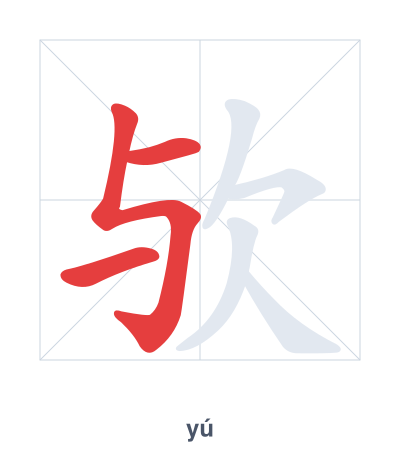
Stroke order practice for 欤 - yú

Practice Writing 欤 (yú)

Open Hanzi Writer to see the animated stroke order and practice writing 欤 with real-time feedback.

The character (yú) is written with 7 strokes. Follow the standard Chinese stroke order: top to bottom, left to right, outside before inside. The radical is one of its key components.

Practice the correct stroke order with the Hanzi Writer app to see animated stroke-by-stroke guidance with real-time feedback.

means A sentence-final particle (literary).

Character
Pinyinyú (yu)
MeaningA sentence-final particle (literary)
Strokes7
Radical
Difficulty3.5/5

欤 is a phonetic compound: 与 (yǔ) provides the sound, while 欠 (qiàn, 'to yawn/lack') hints at the breathy, sentence-ending particle used in literary questions or exclamations.

💡 Memory Tip: Imagine a person yawning (欠) while handing over (与) a question mark at the end of a sentence.

A sentence-final particle (literary)
tàn yú
to sigh (literary)
fǒu yú
Is it so or not?

此言信欤?

cǐ yán xìn yú

Is this statement true?

令人叹欤。

lìng rén tàn yú

It makes one sigh.

然欤否欤?

rán yú fǒu yú

Is it so or not?

Character Pinyin Strokes Radical
(current) 7
6
huān 6
xīn 8
Stroke order practice for 欤 - yú

Practice Writing 欤 (yú)

Open Hanzi Writer to see the animated stroke order and practice writing 欤 with real-time feedback.

✨ Animated stroke order · Handwriting recognition · HSK-graded practice · Free to use

Frequently Asked Questions about 欤

The character 欤 is composed of 与 (yǔ) on the left and 欠 (qiàn) on the right. 欠 originally relates to breath or sighing, which fits the character's use as a sentence-final particle expressing exclamation or question. The left component 与 provides the pronunciation yǔ, which becomes yú in this particle.

Characters with Radical 欠

Other 7-Stroke Characters