抱 (bào) means "to hug or hold in arms" in Chinese. It has 8 strokes with the radical 扌, and is HSK Level 4.
Rated 3.7/5 in difficulty (challenging).
Harder than 44% of HSK Level 4 characters.
Appears in 3+ common words including 拥抱 (yōng bào), 抱歉 (bào qiàn), 抱着 (bào zhe).
Due to its 8 strokes, Hanzi Writer's error detection shows 抱 requires focused practice — most learners need 10+ attempts for consistent accuracy.
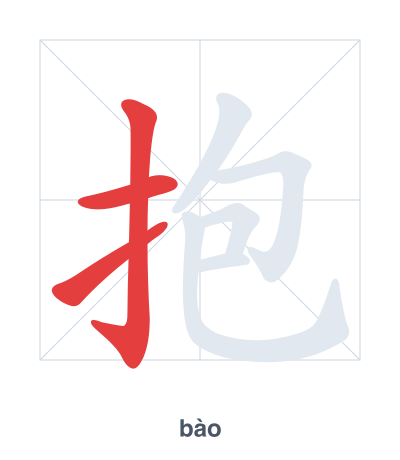
Open Hanzi Writer to see the animated stroke order and practice writing 抱 with real-time feedback.
The character 抱 (bào) is written with 8 strokes. Follow the standard Chinese stroke order: top to bottom, left to right, outside before inside. The radical 扌 is one of its key components.
Practice the correct stroke order with the Hanzi Writer app to see animated stroke-by-stroke guidance with real-time feedback.
抱 means to hug or hold in arms.
As an HSK Level 4 character, 抱 is an intermediate-level character.
抱 combines the hand radical 扌 with 包 (bāo, 'to wrap'), which also provides the sound. The original meaning is to use one's arms to wrap around someone or something, like a hug.
💡 Memory Tip: Imagine your hand (扌) wrapping around a big wrapped package (包) to give it a warm hug.
他们互相拥抱。
tā men hù xiāng yōng bào
They are hugging each other.
非常抱歉,我迟到了。
fēi cháng bào qiàn wǒ chí dào le
I am very sorry, I'm late.
她抱着一个小猫。
tā bào zhe yí gè xiǎo māo
She is holding a kitten.
Open Hanzi Writer to see the animated stroke order and practice writing 抱 with real-time feedback.
✨ Animated stroke order · Handwriting recognition · HSK-graded practice · Free to use
抱 is formed by the radical 扌 (hand) on the left and 包 (bāo, meaning "to wrap" or "bundle") on the right. Together, they suggest the action of wrapping your arms around something, which is exactly the meaning "to hug or hold in arms."