刊 (kān) means "to publish" in Chinese. It has 5 strokes with the radical 刂, and is HSK Level 6.
Rated 2.7/5 in difficulty (moderate).
Harder than 3% of HSK Level 6 characters.
Appears in 3+ common words including 报刊 (bào kān), 周刊 (zhōu kān), 刊登 (kān dēng).
Hanzi Writer's stroke validation shows learners typically need 5-8 attempts to write 刊 with correct proportion and order.
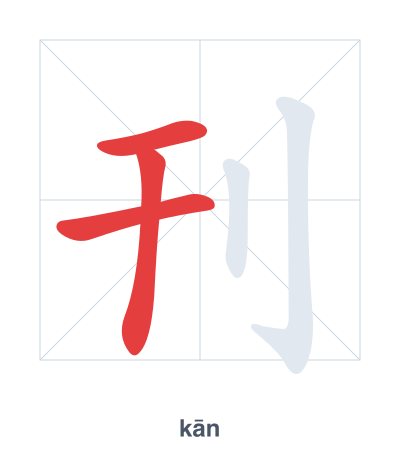
Open Hanzi Writer to see the animated stroke order and practice writing 刊 with real-time feedback.
The character 刊 (kān) is written with 5 strokes. Follow the standard Chinese stroke order: top to bottom, left to right, outside before inside. The radical 刂 is one of its key components.
Practice the correct stroke order with the Hanzi Writer app to see animated stroke-by-stroke guidance with real-time feedback.
刊 means to publish.
As an HSK Level 6 character, 刊 is an intermediate-level character.
刊 combines the phonetic component 干 (gān) with the radical 刂 (knife). It originally meant to carve or cut characters into woodblocks for printing, which later evolved into the modern meaning 'to publish'.
💡 Memory Tip: Imagine using a knife (刂) to carve a copyright symbol © onto a sign (干) to publish your work.
报刊亭在路边。
bào kān tíng zài lù biān
The newsstand is by the roadside.
我订阅了这本周刊。
wǒ dìng yuè le zhè běn zhōu kān
I subscribed to this weekly magazine.
报纸刊登了新闻。
bào zhǐ kān dēng le xīn wén
The newspaper published the news.
Open Hanzi Writer to see the animated stroke order and practice writing 刊 with real-time feedback.
✨ Animated stroke order · Handwriting recognition · HSK-graded practice · Free to use
刊 combines 干 (a tree trunk or tool) on the left with 刂 (knife) on the right. The knife radical suggests cutting or carving, because ancient Chinese characters were carved into wood or bamboo for publishing. Thus 刊 means 'to publish' or 'to print (by carving)'.