惨 (cǎn) means "miserable; tragic" in Chinese. It has 11 strokes with the radical 忄, and is HSK Level 6.
Rated 4.2/5 in difficulty (advanced).
Harder than 60% of HSK Level 6 characters.
Appears in 3+ common words including 悲惨 (bēi cǎn), 惨重 (cǎn zhòng), 惨叫 (cǎn jiào).
Due to its 11 strokes, Hanzi Writer's error detection shows 惨 requires focused practice — most learners need 10+ attempts for consistent accuracy.
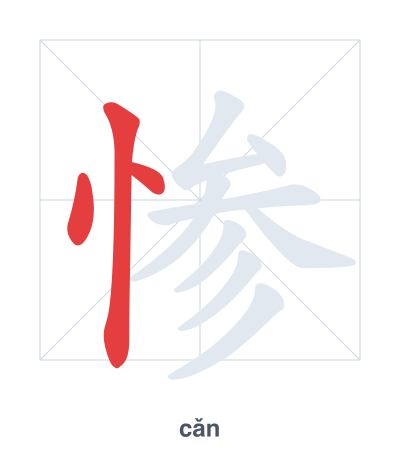
Open Hanzi Writer to see the animated stroke order and practice writing 惨 with real-time feedback.
The character 惨 (cǎn) is written with 11 strokes. Follow the standard Chinese stroke order: top to bottom, left to right, outside before inside. The radical 忄 is one of its key components.
Practice the correct stroke order with the Hanzi Writer app to see animated stroke-by-stroke guidance with real-time feedback.
惨 means miserable; tragic.
As an HSK Level 6 character, 惨 is an intermediate-level character.
This compound character combines the heart radical 忄 (xīn, indicating emotions or feelings) with the phonetic component 参 (cān). Originally meaning 'cruel' or 'ruthless,' it described a harsh state of mind, and later evolved to mean 'miserable' or 'tragic.'
💡 Memory Tip: Picture a heart (忄) next to a person (参) with three tears (彡) streaming down, overwhelmed by tragedy.
这个故事很悲惨。
zhè ge gù shì hěn bēi cǎn
This story is very tragic.
损失非常惨重。
sǔn shī fēi cháng cǎn zhòng
The losses were very heavy.
传来一声惨叫。
chuán lái yī shēng cǎn jiào
A blood-curdling scream was heard.
Open Hanzi Writer to see the animated stroke order and practice writing 惨 with real-time feedback.
✨ Animated stroke order · Handwriting recognition · HSK-graded practice · Free to use
惨 combines the radical 忄 (heart) on the left and 参 (cān, to participate) on the right as a phonetic component. The heart radical connects the character to emotions and feelings, so 惨 expresses the emotional state of being miserable or tragic.