欣 (xīn) means "Joyful" in Chinese. It has 8 strokes with the radical 欠, and is HSK Level 5.
Rated 3.7/5 in difficulty (challenging).
Harder than 37% of HSK Level 5 characters.
Appears in 3+ common words including 欣赏 (xīn shǎng), 欣慰 (xīn wèi), 欣喜 (xīn xǐ).
Due to its 8 strokes, Hanzi Writer's error detection shows 欣 requires focused practice — most learners need 10+ attempts for consistent accuracy.
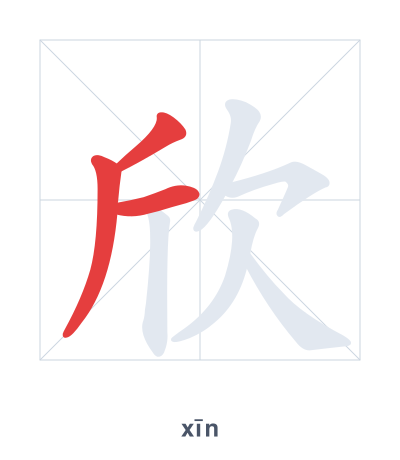
Open Hanzi Writer to see the animated stroke order and practice writing 欣 with real-time feedback.
The character 欣 (xīn) is written with 8 strokes. Follow the standard Chinese stroke order: top to bottom, left to right, outside before inside. The radical 欠 is one of its key components.
Practice the correct stroke order with the Hanzi Writer app to see animated stroke-by-stroke guidance with real-time feedback.
欣 means Joyful.
As an HSK Level 5 character, 欣 is an intermediate-level character.
The character 欣 combines the semantic radical 欠, depicting an open mouth or yawn to suggest sound or expression, with 斤 (axe) as a phonetic component. Together, the open mouth evokes laughter or singing, conveying the meaning of joy or delight.
💡 Memory Tip: Imagine an axe (斤) that makes you so happy you open your mouth wide (欠) in joyful laughter.
我很欣赏他的画。
wǒ hěn xīn shǎng tā de huà
I really appreciate his paintings.
老师感到很欣慰。
lǎo shī gǎn dào hěn xīn wèi
The teacher feels very gratified.
听到消息他很欣喜。
tīng dào xiāo xī tā hěn xīn xǐ
He was very joyful to hear the news.
Open Hanzi Writer to see the animated stroke order and practice writing 欣 with real-time feedback.
✨ Animated stroke order · Handwriting recognition · HSK-graded practice · Free to use
欣 is made of two parts: 斤 on the left (meaning axe) and 欠 on the right (meaning yawn or open mouth). Together, they suggest someone expressing joy with an open mouth, like a cheerful shout after using an axe to finish work. The 欠 component links to sounds or emotions, so 欣 captures the idea of joyful exclamation.