欮 (jué) means "To faint" in Chinese. It has 10 strokes with the radical 欠.
Rated 4.2/5 in difficulty (advanced).
Appears in 3+ common words including 气欮 (qì jué), 欮然 (jué rán), 欮逆 (jué nì).
Due to its 10 strokes, Hanzi Writer's error detection shows 欮 requires focused practice — most learners need 10+ attempts for consistent accuracy.
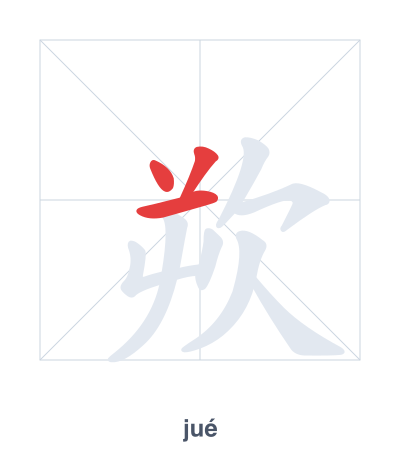
Open Hanzi Writer to see the animated stroke order and practice writing 欮 with real-time feedback.
The character 欮 (jué) is written with 10 strokes. Follow the standard Chinese stroke order: top to bottom, left to right, outside before inside. The radical 欠 is one of its key components.
Practice the correct stroke order with the Hanzi Writer app to see animated stroke-by-stroke guidance with real-time feedback.
欮 means To faint.
| Character | 欮 |
| Pinyin | jué (jue) |
| Meaning | To faint |
| Strokes | 10 |
| Radical | 欠 |
| Difficulty | 4.2/5 |
This compound character combines 欠 (mouth open, yawn) with 屲 (a fallen figure or downward slope). Together, they depict a person losing breath and collapsing, which leads to fainting.
💡 Memory Tip: A person (屲) yawns widely (欠) and suddenly crumples to the ground in a faint.
他气欮倒地。
tā qì jué dǎo dì
He fainted from anger.
他欮然长叹。
tā jué rán cháng tàn
He sighed deeply in distress.
气息欮逆。
qì xī jué nì
The breath is obstructed.
Open Hanzi Writer to see the animated stroke order and practice writing 欮 with real-time feedback.
✨ Animated stroke order · Handwriting recognition · HSK-graded practice · Free to use
欮 combines the radical 欠 (qiàn), which means 'to yawn' or 'lack', and the phonetic component 厥 (jué). The 欠 radical suggests something related to breath or airflow, linking to fainting from breath blockage. The full character 欮 thus conveys the idea of breath failing or being interrupted, leading to a faint.