残 (cán) means "remnant; incomplete; cruel" in Chinese. It has 9 strokes with the radical 歹, and is HSK Level 6.
Rated 4/5 in difficulty (challenging).
Harder than 48% of HSK Level 6 characters.
Appears in 3+ common words including 残疾 (cán jí), 残酷 (cán kù), 残留 (cán liú).
Due to its 9 strokes, Hanzi Writer's error detection shows 残 requires focused practice — most learners need 10+ attempts for consistent accuracy.
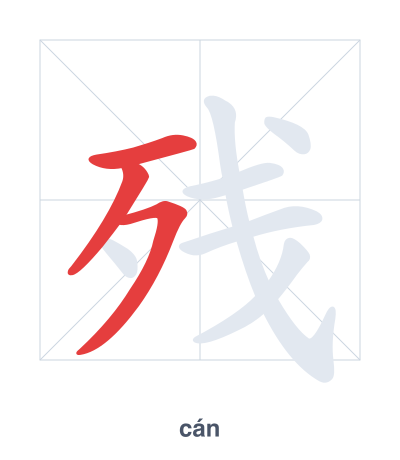
Open Hanzi Writer to see the animated stroke order and practice writing 残 with real-time feedback.
The character 残 (cán) is written with 9 strokes. Follow the standard Chinese stroke order: top to bottom, left to right, outside before inside. The radical 歹 is one of its key components.
Practice the correct stroke order with the Hanzi Writer app to see animated stroke-by-stroke guidance with real-time feedback.
残 means remnant; incomplete; cruel.
As an HSK Level 6 character, 残 is an intermediate-level character.
The left side 歹 (dǎi) originally depicted a broken bone or remnant of death, representing something ruined or incomplete. The right side 戋 (jiān) means 'small' or 'few,' and together they suggest something left over in tiny, damaged pieces—hence 'remnant' or 'incomplete.' The sense of 'cruel' derives from the association with death and destruction.
💡 Memory Tip: Picture a jagged bone (歹) with two tiny remnants (戋 as two small fragments) left on a battlefield—cruel and incomplete.
我们要帮助残疾人。
wǒ men yào bāng zhù cán jí rén
We should help people with disabilities.
战争是非常残酷的。
zhàn zhēng shì fēi cháng cán kù de
War is very cruel.
碗里有食物残留。
wǎn lǐ yǒu shí wù cán liú
There are food residues in the bowl.
Open Hanzi Writer to see the animated stroke order and practice writing 残 with real-time feedback.
✨ Animated stroke order · Handwriting recognition · HSK-graded practice · Free to use
The left side is the radical 歹, which originally meant 'bone' or 'death,' often relating to harm or decay. The right side is 戋 (jiān), which means 'small' or 'few' and hints at something reduced. Together, they suggest a state of being damaged, left over, or incomplete — like something that remains after harm.