欲 (yù) means "Desire or want" in Chinese. It has 11 strokes with the radical 欠, and is HSK Level 6.
Rated 4.2/5 in difficulty (advanced).
Harder than 71% of HSK Level 6 characters.
Appears in 3+ common words including 欲望 (yù wàng), 食欲 (shí yù), 随心所欲 (suí xīn suǒ yù).
Due to its 11 strokes, Hanzi Writer's error detection shows 欲 requires focused practice — most learners need 10+ attempts for consistent accuracy.
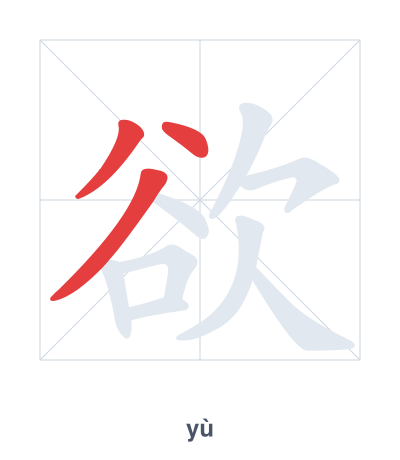
Open Hanzi Writer to see the animated stroke order and practice writing 欲 with real-time feedback.
The character 欲 (yù) is written with 11 strokes. Follow the standard Chinese stroke order: top to bottom, left to right, outside before inside. The radical 欠 is one of its key components.
Practice the correct stroke order with the Hanzi Writer app to see animated stroke-by-stroke guidance with real-time feedback.
欲 means Desire or want.
As an HSK Level 6 character, 欲 is an intermediate-level character.
Combines 欠 (lack, yawn) and 谷 (valley, phonetic), symbolizing a gap or absence that stirs longing. The character originally depicted someone opening their mouth (欠) as if sighing over a missing object, evolving into the abstract sense of desire or want.
💡 Memory Tip: Picture a person (欠) peering into a deep valley (谷), mouth agape with intense yearning for what lies below.
他的欲望很强烈。
tā de yù wàng hěn qiáng liè
His desire is very strong.
我今天没有食欲。
wǒ jīn tiān méi yǒu shí yù
I have no appetite today.
你不能随心所欲。
nǐ bù néng suí xīn suǒ yù
You can't just do as you please.
Open Hanzi Writer to see the animated stroke order and practice writing 欲 with real-time feedback.
✨ Animated stroke order · Handwriting recognition · HSK-graded practice · Free to use
欲 is made of two parts: 谷 (valley) on the left and 欠 (yawn/shortage) on the right. The right part 欠 suggests an open mouth or a lack, so together they imply a feeling of emptiness or yearning, which leads to desire.