款 (kuǎn) means "fund; sum of money; style" in Chinese. It has 12 strokes with the radical 欠, and is HSK Level 5.
Rated 4.2/5 in difficulty (advanced).
Harder than 76% of HSK Level 5 characters.
Appears in 3+ common words including 付款 (fù kuǎn), 新款 (xīn kuǎn), 存款 (cún kuǎn).
Due to its 12 strokes, Hanzi Writer's error detection shows 款 requires focused practice — most learners need 10+ attempts for consistent accuracy.
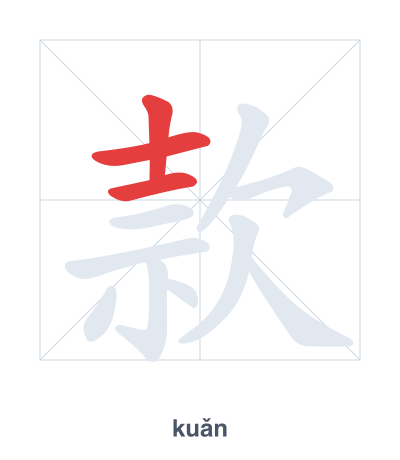
Open Hanzi Writer to see the animated stroke order and practice writing 款 with real-time feedback.
The character 款 (kuǎn) is written with 12 strokes. Follow the standard Chinese stroke order: top to bottom, left to right, outside before inside. The radical 欠 is one of its key components.
Practice the correct stroke order with the Hanzi Writer app to see animated stroke-by-stroke guidance with real-time feedback.
款 means fund; sum of money; style.
As an HSK Level 5 character, 款 is an intermediate-level character.
款 originally combined 欠 (to owe or lack) with a left component (士+示) that suggested a formal gesture or item. This evolved to mean a sincere offering or clause, later extended to a sum of money or a style.
💡 Memory Tip: Picture a scholar (士) showing (示) he owes (欠) a large fund to fund his flashy new style.
请在这里付款。
qǐng zài zhè lǐ fù kuǎn
Please pay here.
这是今年的新款。
zhè shì jīn nián de xīn kuǎn
This is this year's new model.
我的存款不多。
wǒ de cún kuǎn bù duō
I don't have much in savings.
Open Hanzi Writer to see the animated stroke order and practice writing 款 with real-time feedback.
✨ Animated stroke order · Handwriting recognition · HSK-graded practice · Free to use
款 is made of the left component 示 (meaning "show") and the right component 欠 (meaning "lack" or "owe"). Together they suggest "showing a lack" or "what is owed", which relates to its meanings of a sum of money or fund. This structure helps explain why 款 appears in financial words like 付款 (payment).