傈 (lì) means "used in the name of the Lisu ethnic group" in Chinese. It has 12 strokes with the radical 亻.
Rated 3.9/5 in difficulty (challenging).
Appears in 3+ common words including 傈僳族 (lì sù zú), 傈僳语 (lì sù yǔ), 傈人 (lì rén).
Due to its 12 strokes, Hanzi Writer's error detection shows 傈 requires focused practice — most learners need 10+ attempts for consistent accuracy.
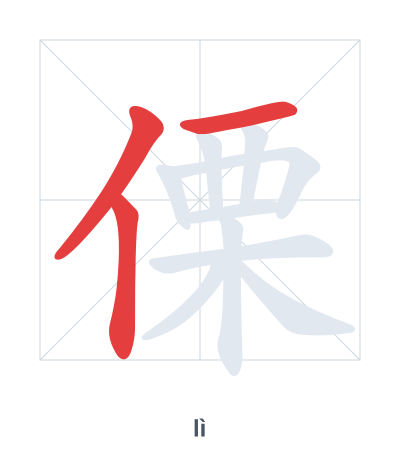
Open Hanzi Writer to see the animated stroke order and practice writing 傈 with real-time feedback.
The character 傈 (lì) is written with 12 strokes. Follow the standard Chinese stroke order: top to bottom, left to right, outside before inside. The radical 亻 is one of its key components.
Practice the correct stroke order with the Hanzi Writer app to see animated stroke-by-stroke guidance with real-time feedback.
傈 means used in the name of the Lisu ethnic group.
傈 is a compound character formed from the radical 亻 (person) and 栗 (lì, chestnut), which acts as a phonetic component. It was created specifically to transcribe the name of the Lisu ethnic group, hence 'person of the Lisu.'
💡 Memory Tip: Picture a Lisu person (亻) holding a chestnut (栗) as a traditional snack while dancing in the mountains.
他是傈僳族人。
tā shì lì sù zú rén
He is of the Lisu ethnic group.
他会说傈僳语。
tā huì shuō lì sù yǔ
He can speak the Lisu language.
这里的傈人很多。
zhè lǐ de lì rén hěn duō
There are many Lisu people here.
Open Hanzi Writer to see the animated stroke order and practice writing 傈 with real-time feedback.
✨ Animated stroke order · Handwriting recognition · HSK-graded practice · Free to use
傈 is made of the radical 亻 (person) on the left and the character 栗 (lì, chestnut) on the right. The 亻 indicates that the character relates to people, and together it forms part of the name for the Lisu ethnic group.