Hanzi Writer

How to Write 傥 (tǎng) — Meaning “if; supposing; unexpected”

tǎng 12 strokes Radical: 亻

傥 (tǎng) means "if; supposing; unexpected" in Chinese. It has 12 strokes with the radical 亻.

Rated 3.9/5 in difficulty (challenging).

Appears in 3+ common words including 傥若 (tǎng ruò), 倜傥 (tì tǎng), 傥然 (tǎng rán).

Due to its 12 strokes, Hanzi Writer's error detection shows 傥 requires focused practice — most learners need 10+ attempts for consistent accuracy.
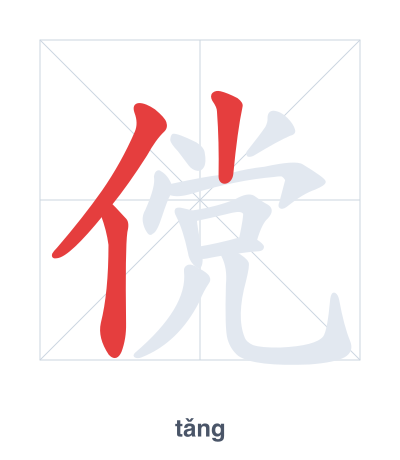
Stroke order practice for 傥 - tǎng

Practice Writing 傥 (tǎng)

Open Hanzi Writer to see the animated stroke order and practice writing 傥 with real-time feedback.

The character (tǎng) is written with 12 strokes. Follow the standard Chinese stroke order: top to bottom, left to right, outside before inside. The radical is one of its key components.

Practice the correct stroke order with the Hanzi Writer app to see animated stroke-by-stroke guidance with real-time feedback.

means if; supposing; unexpected.

Character
Pinyintǎng (tang)
Meaningif; supposing; unexpected
Strokes12
Radical
Difficulty3.9/5

The character 傥 combines the person radical (亻) with 尚 (meaning 'still, yet'), originally depicting a person in an uncertain or unexpected state, thus conveying the idea of 'if' or 'supposing.'

💡 Memory Tip: Imagine a person (亻) standing still (尚) in an unexpected moment, thinking 'what if?' — that's 傥.

tǎng ruò
if; supposing; in case
tì tǎng
free and easy / elegant / unrestrained
tǎng rán
unexpectedly; accidentally; freely

傥若有空,请来我家。

tǎng ruò yǒu kòng qǐng lái wǒ jiā

If you are free, please come to my house.

他长得风流倜傥。

tā zhǎng dé fēng liú tì tǎng

He is elegant and unrestrained.

他表现得很傥然。

tā biǎo xiàn dé hěn tǎng rán

He acted very freely and unconstrained.

Character Pinyin Strokes Radical
(current) tǎng 12
10
10
pái 10
Stroke order practice for 傥 - tǎng

Practice Writing 傥 (tǎng)

Open Hanzi Writer to see the animated stroke order and practice writing 傥 with real-time feedback.

✨ Animated stroke order · Handwriting recognition · HSK-graded practice · Free to use

Frequently Asked Questions about 傥

The character 傥 (tǎng) consists of the radical 亻 (person) on the left and 尚 (shàng) on the right. The person radical ties the character to human actions or qualities, while 尚 often means 'still' or 'yet', contributing a sense of uncertainty or condition. Together, they suggest a person in an "if" or "supposing" situation.

Characters with Radical 亻

Other 12-Stroke Characters