亵 (xiè) means "disrespectful; lewd; undergarment (archaic)" in Chinese. It has 12 strokes with the radical 亠.
Rated 3.9/5 in difficulty (challenging).
Appears in 3+ common words including 亵渎 (xiè dú), 亵衣 (xiè yī), 亵慢 (xiè màn).
Due to its 12 strokes, Hanzi Writer's error detection shows 亵 requires focused practice — most learners need 10+ attempts for consistent accuracy.
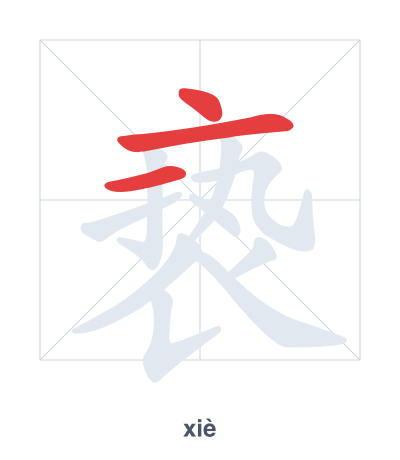
Open Hanzi Writer to see the animated stroke order and practice writing 亵 with real-time feedback.
The character 亵 (xiè) is written with 12 strokes. Follow the standard Chinese stroke order: top to bottom, left to right, outside before inside. The radical 亠 is one of its key components.
Practice the correct stroke order with the Hanzi Writer app to see animated stroke-by-stroke guidance with real-time feedback.
亵 means disrespectful; lewd; undergarment (archaic).
| Character | 亵 |
| Pinyin | xiè (xie) |
| Meaning | disrespectful; lewd; undergarment (archaic) |
| Strokes | 12 |
| Radical | 亠 |
| Difficulty | 3.9/5 |
The character 亵 originally meant 'undergarment' (inner clothing). The simplified form combines 亠 (a dot and horizontal line) with 口 (mouth) and 衣 (clothing), possibly as a simplified phonetic structure, hinting at something intimate or hidden. This led to extended meanings of 'disrespectful' and 'lewd' because undergarments are private and not to be exposed.
💡 Memory Tip: Imagine a person with a dot head (亠) and a wide, leering mouth (口) wearing only an undergarment (衣) — that's disrespectful and lewd.
我们不能亵渎神灵。
wǒ men bù néng xiè dú shén líng
We must not blaspheme the gods.
这是古代的一种内衣。
zhè shì gǔ dài de yī zhǒng nèi yī
This is a type of ancient underwear.
这种态度非常亵慢。
zhè zhǒng tài dù fēi cháng xiè màn
This attitude is very disrespectful and insolent.
Open Hanzi Writer to see the animated stroke order and practice writing 亵 with real-time feedback.
✨ Animated stroke order · Handwriting recognition · HSK-graded practice · Free to use
亵 is composed of the radical 亠 (lid or top) at the top, with 衣 (clothing) at the bottom and 执 (to hold) in the middle. The top component suggests a covering, while 衣 relates to garments and 执 implies handling, together hinting at handling undergarments (archaic meaning) or treating disrespectfully.