傕 (jué) means "used in ancient names" in Chinese. It has 12 strokes with the radical 亻.
Rated 3.9/5 in difficulty (challenging).
Appears in 3+ common words including 李傕 (lǐ jué), 傕傕 (jué jué), 姓傕 (xìng jué).
Due to its 12 strokes, Hanzi Writer's error detection shows 傕 requires focused practice — most learners need 10+ attempts for consistent accuracy.
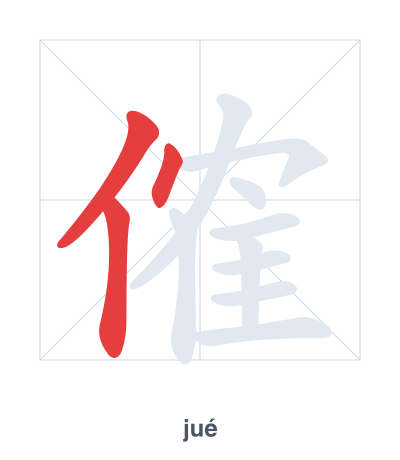
Open Hanzi Writer to see the animated stroke order and practice writing 傕 with real-time feedback.
The character 傕 (jué) is written with 12 strokes. Follow the standard Chinese stroke order: top to bottom, left to right, outside before inside. The radical 亻 is one of its key components.
Practice the correct stroke order with the Hanzi Writer app to see animated stroke-by-stroke guidance with real-time feedback.
傕 means used in ancient names.
傕 is a compound character with the person radical (亻) and the phonetic component 隺, which originally depicted a crane or a bird under a cover. It appears only in ancient personal names, such as the Han dynasty general Li Jue, and has no independent meaning beyond that usage.
💡 Memory Tip: Picture a person (亻) named Jue who always has a crane (隺) perched on his shoulder, making him instantly recognizable in ancient records.
李傕是古代人物。
lǐ jué shì gǔ dài rén wù
Li Jue is a figure from ancient history.
样子看起来傕傕。
yàng zi kàn qǐ lái jué jué
The appearance looks very tall and upright.
他姓傕。
tā xìng jué
His surname is Jue.
Open Hanzi Writer to see the animated stroke order and practice writing 傕 with real-time feedback.
✨ Animated stroke order · Handwriting recognition · HSK-graded practice · Free to use
傕 combines the radical 亻 (person) on the left with the component 隺 on the right. The radical indicates the character relates to a person, while 隺 provides a phonetic clue to the pronunciation jué. This structure is common for characters used in ancient personal names.