新 (xīn) means "new; fresh" in Chinese. It has 13 strokes with the radical 斤, and is HSK Level 1.
Rated 3.7/5 in difficulty (challenging).
Harder than 88% of HSK Level 1 characters.
Appears in 3+ common words including 新年 (xīn nián), 新闻 (xīn wén), 新鲜 (xīn xiān).
Due to its 13 strokes, Hanzi Writer's error detection shows 新 requires focused practice — most learners need 10+ attempts for consistent accuracy.
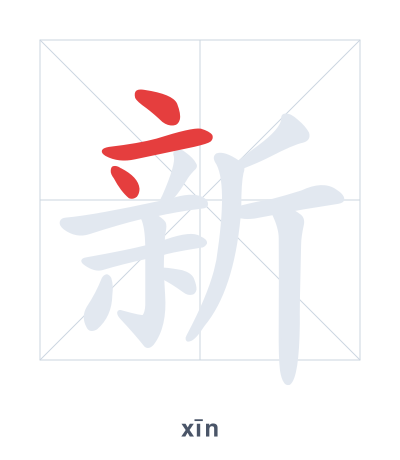
Open Hanzi Writer to see the animated stroke order and practice writing 新 with real-time feedback.
The character 新 (xīn) is written with 13 strokes. Follow the standard Chinese stroke order: top to bottom, left to right, outside before inside. The radical 斤 is one of its key components.
Practice the correct stroke order with the Hanzi Writer app to see animated stroke-by-stroke guidance with real-time feedback.
新 means new; fresh.
As an HSK Level 1 character, 新 is among the first characters beginners learn.
新 originally depicted an axe (斤) cutting a tree (wood) with a chisel (辛), symbolizing freshly cut wood. This idea of 'freshly made' evolved into the meaning of 'new' or 'fresh'.
💡 Memory Tip: Picture your dear parent (亲) swinging a giant axe (斤) to chop down an old tree, making way for a brand new one.
新年快乐!
xīn nián kuài lè
Happy New Year!
我在看新闻。
wǒ zài kàn xīn wén
I am watching the news.
水果很新鲜。
shuǐ guǒ hěn xīn xiān
The fruit is very fresh.
Open Hanzi Writer to see the animated stroke order and practice writing 新 with real-time feedback.
✨ Animated stroke order · Handwriting recognition · HSK-graded practice · Free to use
新 is composed of two parts: the left side is 亲 (qīn, meaning 'parent' or 'close') and the right side is 斤 (jīn, meaning 'axe'). Together, they originally suggested using an axe to cut fresh wood, which came to mean 'new' or 'fresh'.