付 (fù) means "To pay; to hand over" in Chinese. It has 5 strokes with the radical 亻, and is HSK Level 3.
Rated 2.7/5 in difficulty (moderate).
Harder than 11% of HSK Level 3 characters.
Appears in 3+ common words including 付钱 (fù qián), 付出 (fù chū), 支付 (zhī fù).
Hanzi Writer's stroke validation shows learners typically need 5-8 attempts to write 付 with correct proportion and order.
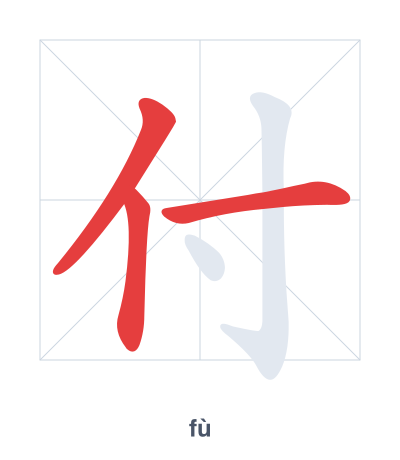
Open Hanzi Writer to see the animated stroke order and practice writing 付 with real-time feedback.
The character 付 (fù) is written with 5 strokes. Follow the standard Chinese stroke order: top to bottom, left to right, outside before inside. The radical 亻 is one of its key components.
Practice the correct stroke order with the Hanzi Writer app to see animated stroke-by-stroke guidance with real-time feedback.
付 means To pay; to hand over.
As an HSK Level 3 character, 付 is an intermediate-level character.
付 combines the radical 亻 (person) and 寸 (hand), originally depicting a person using a hand to hand something over. The hand element '寸' suggests an action of giving or paying, as if physically passing an item from one person to another.
💡 Memory Tip: Imagine a person (亻) handing over a coin measured by a hand (寸) to pay for something.
请到那边付钱。
qǐng dào nà biān fù qián
Please pay over there.
付出总会有回报。
fù chū zǒng huì yǒu huí bào 。
Hard work always pays off.
我用手机支付。
wǒ yòng shǒu jī zhī fù
I pay with my phone.
Open Hanzi Writer to see the animated stroke order and practice writing 付 with real-time feedback.
✨ Animated stroke order · Handwriting recognition · HSK-graded practice · Free to use
付 combines the radical 亻 (person) on the left and 寸 (a hand or measure) on the right. Together, they suggest a person using their hand to hand over or pay something. This structure directly supports the meaning 'to pay' or 'to hand over'.