存 (cún) means "to exist; to save; to store" in Chinese. It has 6 strokes with the radical 子, and is HSK Level 3.
Rated 3.2/5 in difficulty (challenging).
Harder than 29% of HSK Level 3 characters.
Appears in 3+ common words including 存在 (cún zài), 存款 (cún kuǎn), 保存 (bǎo cún).
Due to its 6 strokes, Hanzi Writer's error detection shows 存 requires focused practice — most learners need 10+ attempts for consistent accuracy.
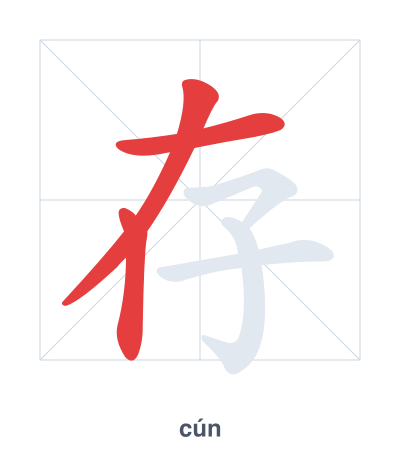
Open Hanzi Writer to see the animated stroke order and practice writing 存 with real-time feedback.
The character 存 (cún) is written with 6 strokes. Follow the standard Chinese stroke order: top to bottom, left to right, outside before inside. The radical 子 is one of its key components.
Practice the correct stroke order with the Hanzi Writer app to see animated stroke-by-stroke guidance with real-time feedback.
存 means to exist; to save; to store.
As an HSK Level 3 character, 存 is an intermediate-level character.
存 combines 子 (child) as a semantic hint for 'being present' and 才 (talent) as a phonetic component. The original meaning was 'to exist' or 'to be present,' later extended to 'to save' or 'store'—keeping something present.
💡 Memory Tip: Picture a child (子) storing a talent (才) in a treasure box so it will always exist.
问题依然存在。
wèn tí yī rán cún zài
The problem still exists.
我去银行存款。
wǒ qù yín háng cún kuǎn
I'm going to the bank to deposit money.
请保存好文件。
qǐng bǎo cún hǎo wén jiàn
Please save the file properly.
Open Hanzi Writer to see the animated stroke order and practice writing 存 with real-time feedback.
✨ Animated stroke order · Handwriting recognition · HSK-graded practice · Free to use
The character 存 combines the radical 子 (child) on top with a simplified form of 才 (talent) below. The radical 子 suggests something ongoing or growing, while the bottom part relates to the idea of "having" or "presence," together implying existence or storage.