傣 (dǎi) means "Dai ethnic group" in Chinese. It has 12 strokes with the radical 亻.
Rated 3.9/5 in difficulty (challenging).
Appears in 3+ common words including 傣族 (dǎi zú), 傣味 (dǎi wèi), 傣家 (dǎi jiā).
Due to its 12 strokes, Hanzi Writer's error detection shows 傣 requires focused practice — most learners need 10+ attempts for consistent accuracy.
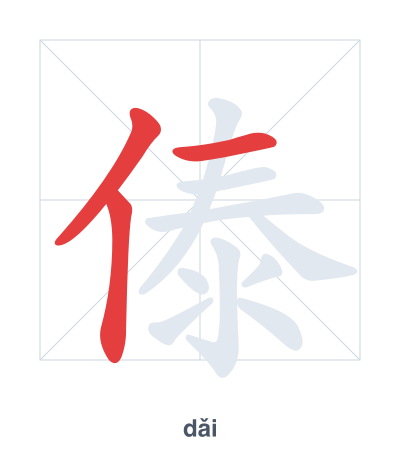
Open Hanzi Writer to see the animated stroke order and practice writing 傣 with real-time feedback.
The character 傣 (dǎi) is written with 12 strokes. Follow the standard Chinese stroke order: top to bottom, left to right, outside before inside. The radical 亻 is one of its key components.
Practice the correct stroke order with the Hanzi Writer app to see animated stroke-by-stroke guidance with real-time feedback.
傣 means Dai ethnic group.
傣 combines the person radical 亻 (people) with 泰 (tài, 'peaceful'), which serves as a phonetic component and also hints at the Dai people's traditionally peaceful agrarian culture. This compound character is used specifically to denote the Dai ethnic group in China.
💡 Memory Tip: Picture a person (亻) sitting peacefully by a grand river (泰), embodying the harmonious life of the Dai people.
傣族有泼水节。
dǎi zú yǒu pō shuǐ jié
The Dai people have the Water Splashing Festival.
我喜欢吃傣味。
wǒ xǐ huān chī dǎi wèi
I like eating Dai-style cuisine.
去傣家竹楼玩。
qù dǎi jiā zhú lóu wán
Go to the Dai bamboo house for fun.
Open Hanzi Writer to see the animated stroke order and practice writing 傣 with real-time feedback.
✨ Animated stroke order · Handwriting recognition · HSK-graded practice · Free to use
傣 (dǎi) is made of the radical 亻 (person) on the left and a phonetic component 泰 (tài) on the right, which hints at the pronunciation. The person radical indicates the character relates to a group of people, specifically the Dai ethnic group.