傧 (bīn) means "to receive guests; usher; master of ceremonies" in Chinese. It has 12 strokes with the radical 亻.
Rated 3.9/5 in difficulty (challenging).
Appears in 3+ common words including 傧相 (bīn xiàng), 礼傧 (lǐ bīn), 傧从 (bīn cóng).
Due to its 12 strokes, Hanzi Writer's error detection shows 傧 requires focused practice — most learners need 10+ attempts for consistent accuracy.
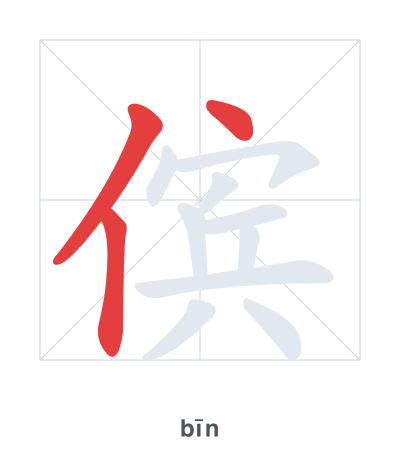
Open Hanzi Writer to see the animated stroke order and practice writing 傧 with real-time feedback.
The character 傧 (bīn) is written with 12 strokes. Follow the standard Chinese stroke order: top to bottom, left to right, outside before inside. The radical 亻 is one of its key components.
Practice the correct stroke order with the Hanzi Writer app to see animated stroke-by-stroke guidance with real-time feedback.
傧 means to receive guests; usher; master of ceremonies.
The character 傧 combines the person radical 亻 with 宾 (guest), depicting a person who guides or attends to visitors. In ancient rituals, the 傧 was the master of ceremonies who formally received and ushered guests, acting as a bridge between the host and visitors.
💡 Memory Tip: Picture a person (亻) holding a sign that says 'Be In!' and cheerfully waving guests into a party.
他在婚礼上当傧相。
tā zài hūn lǐ shàng dàng bīn xiàng
He is a groomsman at the wedding.
礼傧在门口迎接客人。
lǐ bīn zài mén kǒu yíng jiē kè rén
The usher is greeting guests at the door.
官员带着傧从出门。
guān yuán dài zhe bīn cóng chū mén
The official went out with his attendants.
Open Hanzi Writer to see the animated stroke order and practice writing 傧 with real-time feedback.
✨ Animated stroke order · Handwriting recognition · HSK-graded practice · Free to use
The character 傧 is formed by the radical 亻 (person) on the left and 宾 (guest) on the right. This shows a person (亻) who attends to guests (宾), which matches its meaning of receiving guests or being a master of ceremonies.