醉 (zuì) means "drunk" in Chinese. It has 15 strokes with the radical 酉, and is HSK Level 5.
Rated 4.2/5 in difficulty (advanced).
Harder than 96% of HSK Level 5 characters.
Appears in 3+ common words including 喝醉 (hē zuì), 醉酒 (zuì jiǔ), 陶醉 (táo zuì).
Due to its 15 strokes, Hanzi Writer's error detection shows 醉 requires focused practice — most learners need 10+ attempts for consistent accuracy.
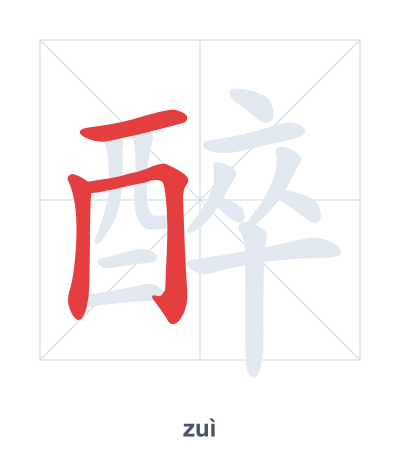
Open Hanzi Writer to see the animated stroke order and practice writing 醉 with real-time feedback.
The character 醉 (zuì) is written with 15 strokes. Follow the standard Chinese stroke order: top to bottom, left to right, outside before inside. The radical 酉 is one of its key components.
Practice the correct stroke order with the Hanzi Writer app to see animated stroke-by-stroke guidance with real-time feedback.
醉 means drunk.
As an HSK Level 5 character, 醉 is an intermediate-level character.
The character 醉 combines the radical 酉 (wine jar) with 卒 (soldier). In ancient China, soldiers were known to drink heavily, so the composition vividly depicts a soldier who has consumed too much wine and is now in a drunken stupor.
💡 Memory Tip: Picture a soldier (卒) collapsing next an overflowing wine jar (酉) because he drank until he was completely drunk.
他昨天喝醉了。
tā zuó tiān hē zuì le
He got drunk yesterday.
醉酒后不能开车。
zuì jiǔ hòu bù néng kāi chē
You cannot drive after drinking alcohol.
我陶醉在美景中。
wǒ táo zuì zài měi jǐng zhōng
I'm enchanted by the beautiful scenery.
Open Hanzi Writer to see the animated stroke order and practice writing 醉 with real-time feedback.
✨ Animated stroke order · Handwriting recognition · HSK-graded practice · Free to use
醉 is made of two parts: the left side 酉, which is the wine radical, and the right side 卒, which originally means 'soldier' or 'sudden'. Together, they suggest a soldier who has drunk too much wine, becoming drunk. This structure directly connects to the meaning of being intoxicated.