陶 (táo) means "pottery or to cultivate" in Chinese. It has 10 strokes with the radical 阝, and is HSK Level 7.
Rated 3.9/5 in difficulty (challenging).
Harder than 37% of HSK Level 7 characters.
Appears in 3+ common words including 陶瓷 (táo cí), 陶艺 (táo yì), 陶醉 (táo zuì).
Due to its 10 strokes, Hanzi Writer's error detection shows 陶 requires focused practice — most learners need 10+ attempts for consistent accuracy.
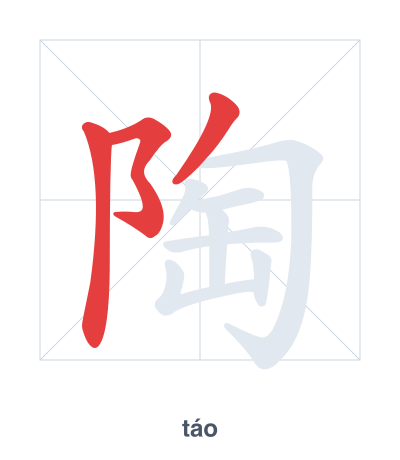
Open Hanzi Writer to see the animated stroke order and practice writing 陶 with real-time feedback.
The character 陶 (táo) is written with 10 strokes. Follow the standard Chinese stroke order: top to bottom, left to right, outside before inside. The radical 阝 is one of its key components.
Practice the correct stroke order with the Hanzi Writer app to see animated stroke-by-stroke guidance with real-time feedback.
陶 means pottery or to cultivate.
As an HSK Level 7 character, 陶 is an intermediate-level character.
陶 combines the radical 阝 (a hill or mound) with 匋, which originally showed a person (勹) shaping clay into a vessel (缶). Ancient potters dug clay from hillsides, so the mound radical connects to the source of material, while 匋 depicts the act of pottery making.
💡 Memory Tip: Imagine a potter on a hill (阝) bending over (勹) to shape a clay jar (缶) into a beautiful piece of pottery.
中国的陶瓷很有名。
zhōng guó de táo cí hěn yǒu míng
Chinese ceramics are very famous.
我在学习陶艺。
wǒ zài xué xí táo yì
I am learning pottery.
他陶醉在音乐中。
tā táo zuì zài yīn yuè zhōng
He is intoxicated by the music.
Open Hanzi Writer to see the animated stroke order and practice writing 陶 with real-time feedback.
✨ Animated stroke order · Handwriting recognition · HSK-graded practice · Free to use
陶 is made of two parts: the left side 阝 (a hill or mound) and the right side 匋 (táo, which gives the sound and relates to pottery). Together they suggest a kiln built on a hillside for making pottery, so the character carries the meaning of pottery or ceramics.