配 (pèi) means "To match / To pair / To fit" in Chinese. It has 10 strokes with the radical 酉, and is HSK Level 3.
Rated 4.2/5 in difficulty (advanced).
Harder than 98% of HSK Level 3 characters.
Appears in 3+ common words including 配合 (pèi hé), 配色 (pèi sè), 搭配 (dā pèi).
Due to its 10 strokes, Hanzi Writer's error detection shows 配 requires focused practice — most learners need 10+ attempts for consistent accuracy.
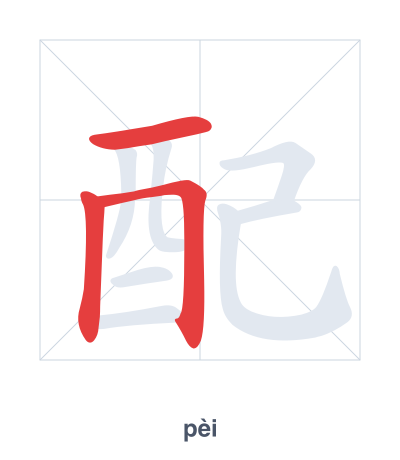
Open Hanzi Writer to see the animated stroke order and practice writing 配 with real-time feedback.
The character 配 (pèi) is written with 10 strokes. Follow the standard Chinese stroke order: top to bottom, left to right, outside before inside. The radical 酉 is one of its key components.
Practice the correct stroke order with the Hanzi Writer app to see animated stroke-by-stroke guidance with real-time feedback.
配 means To match / To pair / To fit.
As an HSK Level 3 character, 配 is an intermediate-level character.
The character 配 combines the radical 酉 (wine jar) with the component 己 (a kneeling person or self). Its original meaning was to blend or mix wine with water, which later extended to the idea of matching or pairing things together.
💡 Memory Tip: Picture a person (己) holding a wine jar (酉) and carefully matching its contents to create the perfect blend for a toast.
谢谢你的配合。
xiè xiè nǐ de pèi hé
Thank you for your cooperation.
这个配色很好看。
zhè ge pèi sè hěn hǎo kàn
This color scheme looks great.
衣服搭配很得体。
yī fú dā pèi hěn dé tǐ
The outfit is very appropriate.
Open Hanzi Writer to see the animated stroke order and practice writing 配 with real-time feedback.
✨ Animated stroke order · Handwriting recognition · HSK-graded practice · Free to use
配 has the radical 酉 on the left, which relates to wine or fermentation. The right side is 己 (self), and together they suggest mixing or matching ingredients like in winemaking — so the character means "to match" or "to pair."