酌 (zhuó) means "To pour wine / To drink / To consider" in Chinese. It has 10 strokes with the radical 酉, and is HSK Level 7.
Rated 4.2/5 in difficulty (advanced).
Harder than 94% of HSK Level 7 characters.
Appears in 3+ common words including 斟酌 (zhēn zhuó), 小酌 (xiǎo zhuó), 对酌 (duì zhuó).
Due to its 10 strokes, Hanzi Writer's error detection shows 酌 requires focused practice — most learners need 10+ attempts for consistent accuracy.
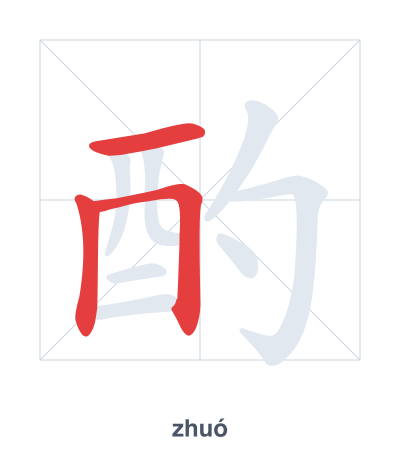
Open Hanzi Writer to see the animated stroke order and practice writing 酌 with real-time feedback.
The character 酌 (zhuó) is written with 10 strokes. Follow the standard Chinese stroke order: top to bottom, left to right, outside before inside. The radical 酉 is one of its key components.
Practice the correct stroke order with the Hanzi Writer app to see animated stroke-by-stroke guidance with real-time feedback.
酌 means To pour wine / To drink / To consider.
As an HSK Level 7 character, 酌 is an intermediate-level character.
The character 酌 combines the radical 酉, representing a wine jar, with 勺, a ladle used for scooping. Together, they depict the action of pouring wine from the jar with a ladle, which extended to mean drinking and, metaphorically, carefully considering (as in 'weighing' one's words).
💡 Memory Tip: Imagine a wine jar (酉) with a long-handled ladle (勺) dipping into it — you pour a cup, then pause to consider if it's enough.
请你仔细斟酌一下。
qǐng nǐ zǐ xì zhēn zhuó yī xià
Please consider it carefully.
我们今晚去小酌几杯。
wǒ men jīn wǎn qù xiǎo zhuó jǐ bēi
Let's go for a few drinks tonight.
两人在月下对酌。
liǎng rén zài yuè xià duì zhuó
The two are drinking together under the moonlight.
Open Hanzi Writer to see the animated stroke order and practice writing 酌 with real-time feedback.
✨ Animated stroke order · Handwriting recognition · HSK-graded practice · Free to use
The character 酌 is composed of the radical 酉 (wine jar) on the left and the component 勺 (spoon) on the right. The wine jar 酉 relates to alcohol and drinks, while the spoon 勺 suggests an action like ladling or pouring. Together they indicate the idea of pouring wine or drinking.