儋 (dān) means "To carry on a shoulder pole; Dan (place name)" in Chinese. It has 15 strokes with the radical 亻.
Rated 3.9/5 in difficulty (challenging).
Appears in 3+ common words including 儋州 (dān zhōu), 负儋 (fù dān), 儋耳 (dān ěr).
Due to its 15 strokes, Hanzi Writer's error detection shows 儋 requires focused practice — most learners need 10+ attempts for consistent accuracy.
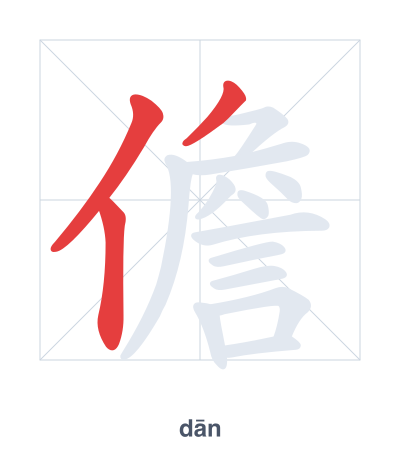
Open Hanzi Writer to see the animated stroke order and practice writing 儋 with real-time feedback.
The character 儋 (dān) is written with 15 strokes. Follow the standard Chinese stroke order: top to bottom, left to right, outside before inside. The radical 亻 is one of its key components.
Practice the correct stroke order with the Hanzi Writer app to see animated stroke-by-stroke guidance with real-time feedback.
儋 means To carry on a shoulder pole; Dan (place name).
儋 is a compound character with the person radical 亻 and the phonetic component 詹 (zhān). It depicts a person carrying a heavy load balanced on a shoulder pole, a common method of transport in ancient China.
💡 Memory Tip: Picture a person (亻) balancing a long pole on their shoulder, with the top of 詹 looking like two heavy sacks hanging from each end.
他住在儋州。
tā zhù zài dān zhōu
He lives in Danzhou.
他的负儋很重。
tā de fù dān hěn zhòng
His burden is very heavy.
这是儋耳郡。
zhè shì dān ěr jùn
This is Dan'er Prefecture.
Open Hanzi Writer to see the animated stroke order and practice writing 儋 with real-time feedback.
✨ Animated stroke order · Handwriting recognition · HSK-graded practice · Free to use
儋 has the radical 亻 on the left, meaning 'person,' which hints at a human action. The right part 詹 provides the pronunciation dān, and together they form the idea of a person carrying something with a shoulder pole.