凛 (lǐn) means "cold; stern; awe-inspiring" in Chinese. It has 15 strokes with the radical 冫.
Rated 3.9/5 in difficulty (challenging).
Appears in 3+ common words including 凛冽 (lǐn liè), 威风凛凛 (wēi fēng lǐn lǐn), 凛然 (lǐn rán).
Due to its 15 strokes, Hanzi Writer's error detection shows 凛 requires focused practice — most learners need 10+ attempts for consistent accuracy.
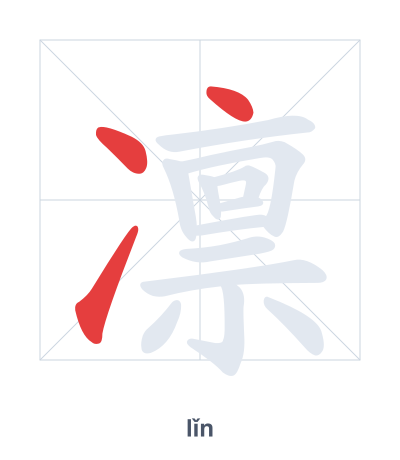
Open Hanzi Writer to see the animated stroke order and practice writing 凛 with real-time feedback.
The character 凛 (lǐn) is written with 15 strokes. Follow the standard Chinese stroke order: top to bottom, left to right, outside before inside. The radical 冫 is one of its key components.
Practice the correct stroke order with the Hanzi Writer app to see animated stroke-by-stroke guidance with real-time feedback.
凛 means cold; stern; awe-inspiring.
| Character | 凛 |
| Pinyin | lǐn (lin) |
| Meaning | cold; stern; awe-inspiring |
| Strokes | 15 |
| Radical | 冫 |
| Difficulty | 3.9/5 |
The left radical 冫 represents ice, directly indicating cold. The right component 禀 (bǐng) originally meant 'to receive from a superior' and adds the connotation of sternness or awe, as in receiving orders with solemn respect. Together, 凛 evokes the chilling, imposing demeanor of something both cold and awe-inspiring.
💡 Memory Tip: Picture a stern ice general (冫) standing before a kneeling official receiving (禀) his frozen orders, sending shivers of respect and terror.
冬天的寒风非常凛冽。
dōng tiān de hán fēng fēi cháng lǐn liè
The winter wind is extremely piercing.
他穿上军装威风凛凛。
tā chuān shàng jūn zhuāng wēi fēng lǐn lǐn
He looked majestic in his military uniform.
他的正气令人凛然起敬。
tā de zhèng qì lìng rén lǐn rán qǐ jìng
His integrity commands awe and respect.
Open Hanzi Writer to see the animated stroke order and practice writing 凛 with real-time feedback.
✨ Animated stroke order · Handwriting recognition · HSK-graded practice · Free to use
The character 凛 has the radical 冫 on the left, which means 'ice' and directly relates to the 'cold' meaning. The right part is 禀, which gives the pronunciation lǐn and also contributes to the idea of receiving something sternly or with awe, reinforcing the 'stern' and 'awe-inspiring' meanings.