酏 (yǐ) means "Elixir / Sweet wine" in Chinese. It has 10 strokes with the radical 酉.
Rated 4.2/5 in difficulty (advanced).
Appears in 3+ common words including 酏剂 (yǐ jì), 酏醴 (yǐ lǐ), 黍酏 (shǔ yǐ).
Due to its 10 strokes, Hanzi Writer's error detection shows 酏 requires focused practice — most learners need 10+ attempts for consistent accuracy.
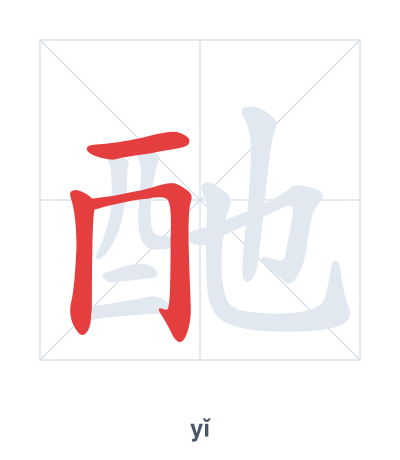
Open Hanzi Writer to see the animated stroke order and practice writing 酏 with real-time feedback.
The character 酏 (yǐ) is written with 10 strokes. Follow the standard Chinese stroke order: top to bottom, left to right, outside before inside. The radical 酉 is one of its key components.
Practice the correct stroke order with the Hanzi Writer app to see animated stroke-by-stroke guidance with real-time feedback.
酏 means Elixir / Sweet wine.
酏 (yǐ) is a phono-semantic compound where the radical 酉 (wine vessel) indicates its connection to alcoholic drinks, and the phonetic component 也 (yě) hints at the pronunciation. This character originally referred to a type of sweet wine or medicinal elixir in ancient Chinese alchemy, often used in rituals or as a tonic.
💡 Memory Tip: Picture a wine jar (酉) with a serpentine spoon (也) dipping into it to ladle out a glowing, sweet elixir.
这种酏剂是甜的。
zhè zhǒng yǐ jì shì tián de
This elixir is sweet.
酏醴是古代的甜酒。
yǐ lǐ shì gǔ dài de tián jiǔ
Yili is a type of sweet wine from ancient times.
黍酏是用黍米做的。
shǔ yǐ shì yòng shǔ mǐ zuò de
Millet porridge is made from millet.
Open Hanzi Writer to see the animated stroke order and practice writing 酏 with real-time feedback.
✨ Animated stroke order · Handwriting recognition · HSK-graded practice · Free to use
酏 is composed of the radical 酉 (yǒu), which represents a wine jar and is commonly used in characters related to alcohol, and the phonetic component 也 (yě). The 酉 radical gives the meaning of "wine" or "elixir," while 也 provides a pronunciation clue. Together, they form a character that refers to a type of sweet wine or a pharmaceutical elixir.