酊 (dīng/dǐng) means "Tincture" in Chinese. It has 9 strokes with the radical 酉.
Rated 4/5 in difficulty (challenging).
Appears in 3+ common words including 酩酊 (mǐng dǐng), 碘酊 (diǎn dīng), 酊剂 (dīng jì).
Due to its 9 strokes, Hanzi Writer's error detection shows 酊 requires focused practice — most learners need 10+ attempts for consistent accuracy.
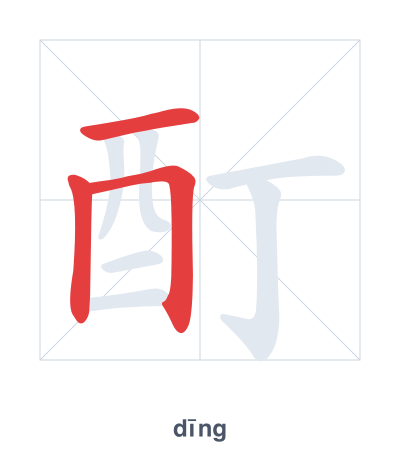
Open Hanzi Writer to see the animated stroke order and practice writing 酊 with real-time feedback.
The character 酊 (dīng/dǐng) is written with 9 strokes. Follow the standard Chinese stroke order: top to bottom, left to right, outside before inside. The radical 酉 is one of its key components.
Practice the correct stroke order with the Hanzi Writer app to see animated stroke-by-stroke guidance with real-time feedback.
酊 means Tincture.
This is a polyphonic character with readings: dīng, dǐng.
The character 酊 combines the radical 酉 (a wine jar, representing alcohol) with the phonetic component 丁 (dīng, meaning 'nail' or 'small'). Together, they evoke a small, concentrated alcoholic extract—a tincture—as the nail-like shape hints at a tiny amount of potent liquid produced from the wine jar.
💡 Memory Tip: Picture a tiny nail (丁) stuck into a wine jar (酉) to drip out a few precious drops of medicinal tincture.
他喝得酩酊大醉。
tā hē dé mǐng dǐng dà zuì
He was hopelessly drunk.
医生用了碘酊消毒。
yī shēng yòng le diǎn dīng xiāo dú
The doctor used tincture of iodine for disinfection.
这种酊剂很有用。
zhè zhǒng dīng jì hěn yǒu yòng
This tincture is very useful.
Open Hanzi Writer to see the animated stroke order and practice writing 酊 with real-time feedback.
✨ Animated stroke order · Handwriting recognition · HSK-graded practice · Free to use
The character 酊 is made of two parts: the radical 酉 (yǒu) on the left, which represents wine or fermentation, and the phonetic component 丁 (dīng) on the right. Together they suggest a liquid made with alcohol, which matches the meaning 'tincture' — a medicine dissolved in alcohol.