酪 (lào) means "cheese or curd" in Chinese. It has 13 strokes with the radical 酉.
Rated 4.2/5 in difficulty (advanced).
Appears in 3+ common words including 奶酪 (nǎi lào), 酪乳 (lào rǔ), 果酪 (guǒ lào).
Due to its 13 strokes, Hanzi Writer's error detection shows 酪 requires focused practice — most learners need 10+ attempts for consistent accuracy.
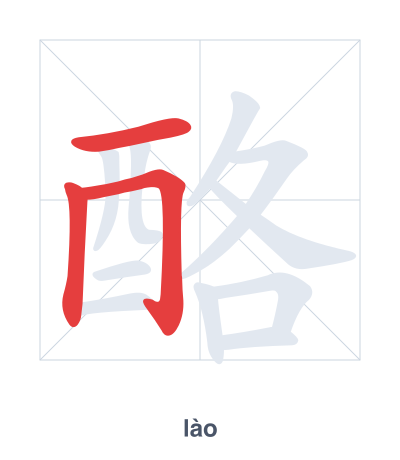
Open Hanzi Writer to see the animated stroke order and practice writing 酪 with real-time feedback.
The character 酪 (lào) is written with 13 strokes. Follow the standard Chinese stroke order: top to bottom, left to right, outside before inside. The radical 酉 is one of its key components.
Practice the correct stroke order with the Hanzi Writer app to see animated stroke-by-stroke guidance with real-time feedback.
酪 means cheese or curd.
The left radical 酉 depicts a wine jar, representing fermentation—a key process in making cheese and curds. The right component 各 (gè) is phonetic, contributing to the pronunciation lào. Together, 酪 refers to dairy products like cheese produced through fermentation or curdling.
💡 Memory Tip: Imagine a wine jar (酉) filled with creamy curds, and each (各) chunk is a tasty piece of cheese.
我喜欢吃奶酪。
wǒ xǐ huān chī nǎi lào
I like eating cheese.
酪乳的味道很酸。
lào rǔ de wèi dào hěn suān
Buttermilk tastes very sour.
这是一个果酪蛋糕。
zhè shì yí gè guǒ lào dàn gāo
This is a fruit cheesecake.
Open Hanzi Writer to see the animated stroke order and practice writing 酪 with real-time feedback.
✨ Animated stroke order · Handwriting recognition · HSK-graded practice · Free to use
The left radical 酉 indicates a connection to fermentation or alcoholic processes, which relates to cheese being a fermented dairy product. The right component 各 (gè) provides a phonetic clue to the pronunciation, though the actual reading lào is slightly different. Together, they create the meaning of a fermented curd.