䠀 (tāng) means "to stride; to walk" in Chinese. It has 15 strokes with the radical 足.
Rated 4.2/5 in difficulty (advanced).
Appears in 3+ common words including 䠀步 (tāng bù), 䠀行 (tāng xíng), 䠀过 (tāng guò).
Due to its 15 strokes, Hanzi Writer's error detection shows 䠀 requires focused practice — most learners need 10+ attempts for consistent accuracy.
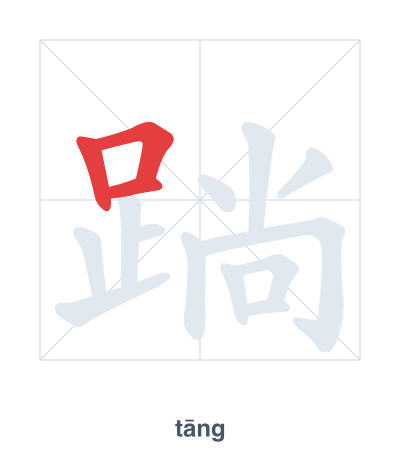
Open Hanzi Writer to see the animated stroke order and practice writing 䠀 with real-time feedback.
The character 䠀 (tāng) is written with 15 strokes. Follow the standard Chinese stroke order: top to bottom, left to right, outside before inside. The radical 足 is one of its key components.
Practice the correct stroke order with the Hanzi Writer app to see animated stroke-by-stroke guidance with real-time feedback.
䠀 means to stride; to walk.
This character is a semantic-phonetic compound. The radical 足 (foot) indicates action of the foot, while the right component 湯 (tāng, 'soup') provides the pronunciation. The meaning 'to stride' or 'to walk' suggests a vigorous stepping motion, as if striding through water.
💡 Memory Tip: Picture your foot (足) striding boldly through a giant bowl of hot soup (湯), splashing as you go.
他大步䠀步向前走。
tā dà bù tāng bù xiàng qián zǒu 。
He strode forward with big steps.
我们在雪地里䠀行。
wǒ men zài xuě dì lǐ tāng xíng 。
We are trudging through the snow.
他䠀过了那条小河。
tā tāng guò le nà tiáo xiǎo hé 。
He waded across that small river.
Open Hanzi Writer to see the animated stroke order and practice writing 䠀 with real-time feedback.
✨ Animated stroke order · Handwriting recognition · HSK-graded practice · Free to use
The character 䠀 is composed of the radical 足 (foot) on the left and the component 尚 (shàng, meaning 'still' or 'upward') on the right. Since 足 relates to feet or walking, and 尚 suggests an upward or forward motion, together they convey the idea of striding or taking a step.