僵 (jiāng) means "stiff / rigid / deadlocked" in Chinese. It has 15 strokes with the radical 亻, and is HSK Level 7.
Rated 3.9/5 in difficulty (challenging).
Harder than 34% of HSK Level 7 characters.
Appears in 3+ common words including 僵硬 (jiāng yìng), 僵局 (jiāng jú), 僵持 (jiāng chí).
Due to its 15 strokes, Hanzi Writer's error detection shows 僵 requires focused practice — most learners need 10+ attempts for consistent accuracy.
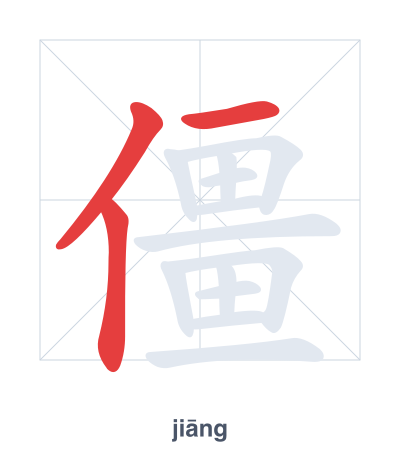
Open Hanzi Writer to see the animated stroke order and practice writing 僵 with real-time feedback.
The character 僵 (jiāng) is written with 15 strokes. Follow the standard Chinese stroke order: top to bottom, left to right, outside before inside. The radical 亻 is one of its key components.
Practice the correct stroke order with the Hanzi Writer app to see animated stroke-by-stroke guidance with real-time feedback.
僵 means stiff / rigid / deadlocked.
As an HSK Level 7 character, 僵 is an intermediate-level character.
The character 僵 combines the radical 亻 (person) with 畺, an ancient form of 疆 meaning 'boundary' or 'border'. A person made as rigid and immobile as a boundary marker evokes the sense of being stiff or deadlocked.
💡 Memory Tip: Imagine a person (亻) frozen solid like a plank, with three horizontal lines (the top of 畺) representing a rigid, unmoving frame.
他的身体很僵硬。
tā de shēn tǐ hěn jiāng yìng
His body is very stiff.
谈判陷入了僵局。
tán pàn xiàn rù le jiāng jú
The negotiations have reached a deadlock.
双方一直僵持着。
shuāng fāng yì zhí jiāng chí zhe
Both sides have been at a stalemate.
Open Hanzi Writer to see the animated stroke order and practice writing 僵 with real-time feedback.
✨ Animated stroke order · Handwriting recognition · HSK-graded practice · Free to use
The character 僵 combines the radical 亻 (person) on the left with 畺 on the right. 畺 originally depicted two fields separated by a boundary, suggesting something stuck or immovable, which together with the person radical conveys a person or situation that is stiff or deadlocked.