劐 (huō) means "to slit / to cut open" in Chinese. It has 15 strokes with the radical 刂.
Rated 3.9/5 in difficulty (challenging).
Appears in 3+ common words including 劐开 (huō kāi), 劐子 (huō zi), 劐地 (huō dì).
Due to its 15 strokes, Hanzi Writer's error detection shows 劐 requires focused practice — most learners need 10+ attempts for consistent accuracy.
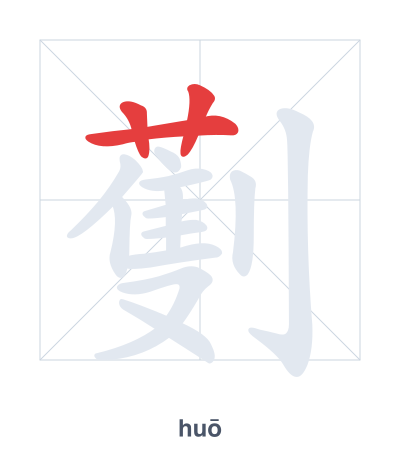
Open Hanzi Writer to see the animated stroke order and practice writing 劐 with real-time feedback.
The character 劐 (huō) is written with 15 strokes. Follow the standard Chinese stroke order: top to bottom, left to right, outside before inside. The radical 刂 is one of its key components.
Practice the correct stroke order with the Hanzi Writer app to see animated stroke-by-stroke guidance with real-time feedback.
劐 means to slit / to cut open.
The character 劐 combines 霍 (huò, meaning 'sudden' or 'quickly') as a phonetic component with the radical 刂 (knife), indicating an action involving a blade. The left component 霍 itself shows a bird (隹) under rain (雨), but in this compound it primarily hints at the sound, while the knife radical conveys the meaning of slitting or cutting open.
💡 Memory Tip: Picture a bird (隹) caught in a sudden rainstorm (雨) being quickly slit open by a knife (刂) on the right.
他把袋子劐开了。
tā bǎ dài zi huō kāi le
He slit the bag open.
农民在用劐子耕地。
nóng mín zài yòng huō zi gēng dì
Farmers are using a small plow to till the land.
这种工具可以劐地。
zhè zhǒng gōng jù kě yǐ huō dì
This tool can be used to plow the ground.
Open Hanzi Writer to see the animated stroke order and practice writing 劐 with real-time feedback.
✨ Animated stroke order · Handwriting recognition · HSK-graded practice · Free to use
The character 劐 is made of two parts: the left side 耒, which represents a plow, and the right side 刂, a knife radical. Together, they suggest using a sharp tool to cut or slit something, often soil or an object. This structure directly supports the meaning of "to slit" or "to cut open."