儇 (xuān) means "Frivolous; smart but superficial" in Chinese. It has 15 strokes with the radical 亻.
Rated 3.9/5 in difficulty (challenging).
Appears in 3+ common words including 儇巧 (xuān qiǎo), 儇薄 (xuān báo), 儇子 (xuān zi).
Due to its 15 strokes, Hanzi Writer's error detection shows 儇 requires focused practice — most learners need 10+ attempts for consistent accuracy.
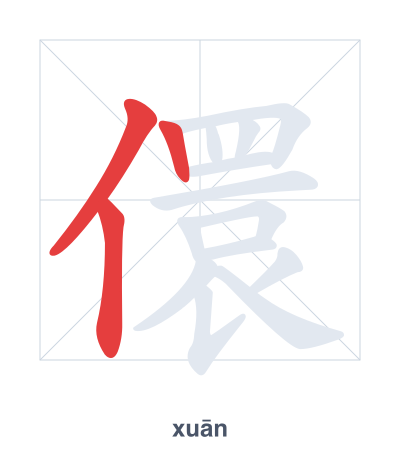
Open Hanzi Writer to see the animated stroke order and practice writing 儇 with real-time feedback.
The character 儇 (xuān) is written with 15 strokes. Follow the standard Chinese stroke order: top to bottom, left to right, outside before inside. The radical 亻 is one of its key components.
Practice the correct stroke order with the Hanzi Writer app to see animated stroke-by-stroke guidance with real-time feedback.
儇 means Frivolous; smart but superficial.
儇 is a compound character with the radical 亻 (person) and the phonetic component 瞏 (xuān), which originally meant 'to look around.' This suggests a person who is constantly glancing about, linking to the meaning of being frivolous and smart but superficial.
💡 Memory Tip: Picture a person (亻) whose face is just two big eyes (like 目 in 瞏) darting around everywhere, never focusing—a frivolous show-off.
他为人儇巧。
tā wéi rén xuān qiǎo
He is clever and nimble.
他的话很儇薄。
tā de huà hěn xuān báo
His words were frivolous.
他是个儇子。
tā shì gè xuān zi
He is a frivolous person.
Open Hanzi Writer to see the animated stroke order and practice writing 儇 with real-time feedback.
✨ Animated stroke order · Handwriting recognition · HSK-graded practice · Free to use
儇 is made of the radical 亻 (person) on the left and 巽 (xùn, meaning weak or permissive) on the right. The person radical indicates a human trait, while 巽 suggests a lack of strength or depth, together describing someone who is frivolous or smart on the surface but lacks real substance.