酐 (gān) means "Anhydride" in Chinese. It has 10 strokes with the radical 酉.
Rated 4.2/5 in difficulty (advanced).
Appears in 3+ common words including 酸酐 (suān gān), 顺酐 (shùn gān), 酞酐 (tài gān).
Due to its 10 strokes, Hanzi Writer's error detection shows 酐 requires focused practice — most learners need 10+ attempts for consistent accuracy.
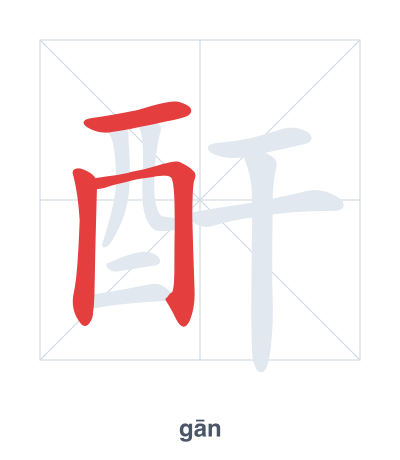
Open Hanzi Writer to see the animated stroke order and practice writing 酐 with real-time feedback.
The character 酐 (gān) is written with 10 strokes. Follow the standard Chinese stroke order: top to bottom, left to right, outside before inside. The radical 酉 is one of its key components.
Practice the correct stroke order with the Hanzi Writer app to see animated stroke-by-stroke guidance with real-time feedback.
酐 means Anhydride.
The character 酐 is a compound formed from the radical 酉, which originally depicted a wine jar and is associated with chemical or fermented substances, combined with 干 (dry). Together, they suggest a dry chemical substance, namely an anhydride, which is a compound derived from an acid by removing water.
💡 Memory Tip: Picture a wine bottle (酉) that has completely dried out (干), leaving behind a white powdery residue—anhydride.
酸酐是化学物质。
suān gān shì huà xué wù zhì
Acid anhydride is a chemical substance.
顺酐是工业原料。
shùn gān shì gōng yè yuán liào
Maleic anhydride is an industrial raw material.
酞酐是白色固体。
tài gān shì bái sè gù tǐ
Phthalic anhydride is a white solid.
Open Hanzi Writer to see the animated stroke order and practice writing 酐 with real-time feedback.
✨ Animated stroke order · Handwriting recognition · HSK-graded practice · Free to use
The character 酐 is composed of the radical 酉 (yǒu, meaning wine or fermentation) on the left, and 干 (gān, meaning dry) on the right. The radical 酉 relates to chemicals or liquids, while 干 hints at the pronunciation and the idea of a substance without water, which fits the chemical meaning of an anhydride.