酋 (qiú) means "Chief / Head of a tribe" in Chinese. It has 9 strokes with the radical 酉.
Rated 4/5 in difficulty (challenging).
Appears in 3+ common words including 酋长 (qiú zhǎng), 敌酋 (dí qiú), 枭酋 (xiāo qiú).
Due to its 9 strokes, Hanzi Writer's error detection shows 酋 requires focused practice — most learners need 10+ attempts for consistent accuracy.
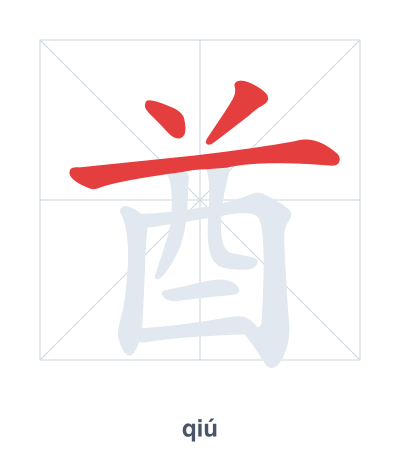
Open Hanzi Writer to see the animated stroke order and practice writing 酋 with real-time feedback.
The character 酋 (qiú) is written with 9 strokes. Follow the standard Chinese stroke order: top to bottom, left to right, outside before inside. The radical 酉 is one of its key components.
Practice the correct stroke order with the Hanzi Writer app to see animated stroke-by-stroke guidance with real-time feedback.
酋 means Chief / Head of a tribe.
The character 酋 originally depicted a jar of aged wine (酉) with a lid or markings (丷) indicating long fermentation, later extended to mean 'tribal chief' because leaders oversaw wine ceremonies.
💡 Memory Tip: Picture the chief with two eagle feathers (丷) sticking out of his head, standing proudly on a wine barrel (酉).
酋长住在山里。
qiú zhǎng zhù zài shān lǐ
The chieftain lives in the mountains.
敌酋被抓住了。
dí qiú bèi zhuā zhù le
The enemy leader was captured.
枭酋逃跑了。
xiāo qiú táo pǎo le
The ringleader has escaped.
Open Hanzi Writer to see the animated stroke order and practice writing 酋 with real-time feedback.
✨ Animated stroke order · Handwriting recognition · HSK-graded practice · Free to use
The character 酋 combines 酉 (wine vessel) at the bottom with a top part that resembles fermented grains or a cover. This structure suggests a connection to brewing or fermentation, linking to tribal leaders who oversaw rituals involving alcohol. The meaning 'chief' evolved from the idea of a leader who presided over such ceremonies.