谓 (wèi) means "to call, say, or mean" in Chinese. It has 11 strokes with the radical 讠, and is HSK Level 4.
Rated 3.9/5 in difficulty (challenging).
Harder than 55% of HSK Level 4 characters.
Appears in 3+ common words including 所谓 (suǒ wèi), 无所谓 (wú suǒ wèi), 称谓 (chēng wèi).
Due to its 11 strokes, Hanzi Writer's error detection shows 谓 requires focused practice — most learners need 10+ attempts for consistent accuracy.
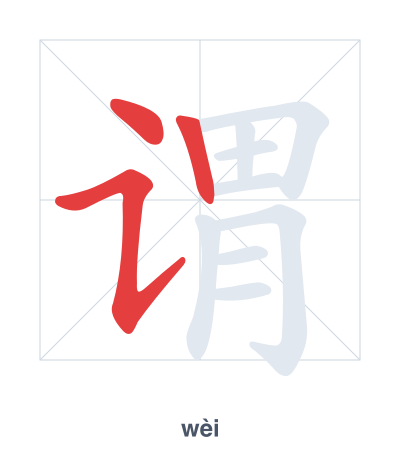
Open Hanzi Writer to see the animated stroke order and practice writing 谓 with real-time feedback.
The character 谓 (wèi) is written with 11 strokes. Follow the standard Chinese stroke order: top to bottom, left to right, outside before inside. The radical 讠 is one of its key components.
Practice the correct stroke order with the Hanzi Writer app to see animated stroke-by-stroke guidance with real-time feedback.
谓 means to call, say, or mean.
As an HSK Level 4 character, 谓 is an intermediate-level character.
谓 combines the speech radical 讠 (a simplified form of 言, meaning 'words') with 胃 (wèi, 'stomach'), which hints at the pronunciation. The original meaning was 'to speak to' or 'to address,' later extended to 'to call' or 'to mean.'
💡 Memory Tip: Imagine a stomach (胃) talking like a person, saying, 'I mean what I say.'
这就是所谓的成功。
zhè jiù shì suǒ wèi de chéng gōng
This is what is called success.
我觉得无所谓。
wǒ jué de wú suǒ wèi
I don't mind.
老师是一个称谓。
lǎo shī shì yí gè chēng wèi
Teacher is a title.
Open Hanzi Writer to see the animated stroke order and practice writing 谓 with real-time feedback.
✨ Animated stroke order · Handwriting recognition · HSK-graded practice · Free to use
The left side of 谓 is the radical 讠, which represents speech or words. The right side 胃 (wèi, stomach) provides the pronunciation. Together, the character conveys the idea of saying or calling something, linking speech with the sound element.