败 (bài) means "to defeat; to fail; to lose" in Chinese. It has 8 strokes with the radical 贝, and is HSK Level 4.
Rated 3.7/5 in difficulty (challenging).
Harder than 49% of HSK Level 4 characters.
Appears in 3+ common words including 失败 (shī bài), 打败 (dǎ bài), 胜败 (shèng bài).
Due to its 8 strokes, Hanzi Writer's error detection shows 败 requires focused practice — most learners need 10+ attempts for consistent accuracy.
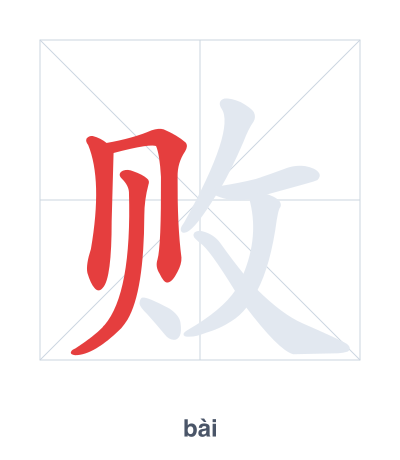
Open Hanzi Writer to see the animated stroke order and practice writing 败 with real-time feedback.
The character 败 (bài) is written with 8 strokes. Follow the standard Chinese stroke order: top to bottom, left to right, outside before inside. The radical 贝 is one of its key components.
Practice the correct stroke order with the Hanzi Writer app to see animated stroke-by-stroke guidance with real-time feedback.
败 means to defeat; to fail; to lose.
As an HSK Level 4 character, 败 is an intermediate-level character.
败 combines 贝 (shell, ancient currency representing value) and 攵 (a hand holding a stick, indicating an action). The character originally depicted striking or damaging wealth, symbolizing loss or failure in a transaction or battle.
💡 Memory Tip: Picture a hand (攵) smashing a shell coin (贝) into pieces — that's a costly defeat (败).
失败是成功之母。
shī bài shì chéng gōng zhī mǔ
Failure is the mother of success.
我们打败了对手。
wǒ men dǎ bài le duì shǒu
We defeated our opponents.
胜败并不重要。
shèng bài bìng bú zhòng yào
Success or failure is not important.
Open Hanzi Writer to see the animated stroke order and practice writing 败 with real-time feedback.
✨ Animated stroke order · Handwriting recognition · HSK-graded practice · Free to use
The character 败 is made of two parts: the left side 贝 (shell, representing money) and the right side 攵 (an action of hitting or striking). Together, they suggest the idea of losing money or being hit in a transaction, which connects to the meanings of defeat, failure, or loss.