无 (wú) means "None, without, or not." in Chinese. It has 4 strokes with the radical 无, and is HSK Level 4.
Rated 2/5 in difficulty (beginner-friendly).
Harder than 1% of HSK Level 4 characters.
Appears in 3+ common words including 无聊 (wú liáo), 无论 (wú lùn), 无法 (wú fǎ).
In the Hanzi Writer app, most learners master 无 within 3 practice attempts using stroke-by-stroke animation.
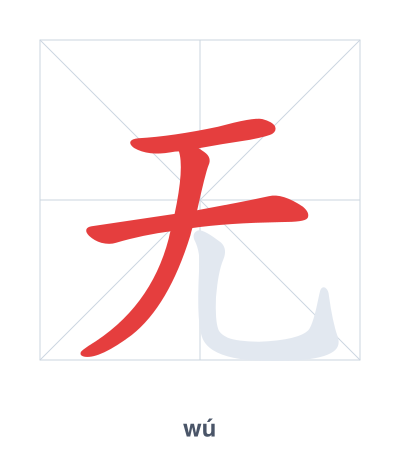
Open Hanzi Writer to see the animated stroke order and practice writing 无 with real-time feedback.
The character 无 (wú) is written with 4 strokes. Follow the standard Chinese stroke order: top to bottom, left to right, outside before inside. The radical 无 is one of its key components.
Practice the correct stroke order with the Hanzi Writer app to see animated stroke-by-stroke guidance with real-time feedback.
无 means None, without, or not..
As an HSK Level 4 character, 无 is an intermediate-level character.
The ancient form of 无 depicted a person with arms raised, a gesture of showing empty hands, symbolizing 'nothing' or 'absence.' Over time, the shape simplified into the modern four-stroke character.
💡 Memory Tip: Picture a stick figure raising both arms with empty hands, as if saying 'I have nothing!'—that shape is 无.
这个电影很无聊。
zhè ge diàn yǐng hěn wú liáo
This movie is very boring.
无论你去哪,我都去。
wú lùn nǐ qù nǎ wǒ dōu qù
No matter where you go, I will go.
我无法回答这个问题。
wǒ wú fǎ huí dá zhè ge wèn tí
I cannot answer this question.
Open Hanzi Writer to see the animated stroke order and practice writing 无 with real-time feedback.
✨ Animated stroke order · Handwriting recognition · HSK-graded practice · Free to use
The character 无 is a single radical; it is not broken into smaller components. Its shape, resembling a simplified version of a person with arms crossed, suggests the idea of having nothing or denying something.