置 (zhì) means "To put; to place; to set up" in Chinese. It has 13 strokes with the radical 罒, and is HSK Level 4.
Rated 4.2/5 in difficulty (advanced).
Harder than 87% of HSK Level 4 characters.
Appears in 3+ common words including 位置 (wèi zhì), 布置 (bù zhì), 放置 (fàng zhì).
Due to its 13 strokes, Hanzi Writer's error detection shows 置 requires focused practice — most learners need 10+ attempts for consistent accuracy.
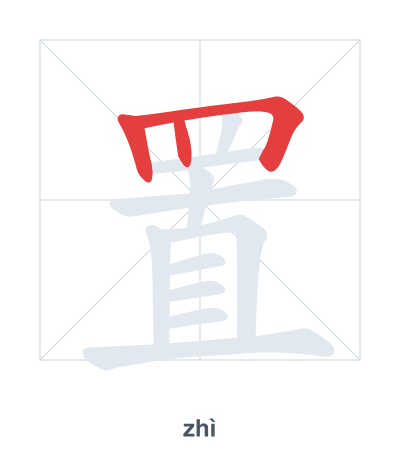
Open Hanzi Writer to see the animated stroke order and practice writing 置 with real-time feedback.
The character 置 (zhì) is written with 13 strokes. Follow the standard Chinese stroke order: top to bottom, left to right, outside before inside. The radical 罒 is one of its key components.
Practice the correct stroke order with the Hanzi Writer app to see animated stroke-by-stroke guidance with real-time feedback.
置 means To put; to place; to set up.
As an HSK Level 4 character, 置 is an intermediate-level character.
置 combines 罒 (a net) and 直 (straight). The net represents a structure to be set up, and 直 adds the sense of making it straight or correct, so the character means 'to place' or 'to set up'.
💡 Memory Tip: Picture placing a straight stick (直) under a net (罒) to set up a trap.
你的位置在哪里?
nǐ de wèi zhì zài nǎ lǐ
Where is your location?
房间布置得很温馨。
fáng jiān bù zhì dé hěn wēn xīn
The room is decorated very cozily.
请把书放置在桌上。
qǐng bǎ shū fàng zhì zài zhuō shàng
Please place the book on the table.
Open Hanzi Writer to see the animated stroke order and practice writing 置 with real-time feedback.
✨ Animated stroke order · Handwriting recognition · HSK-graded practice · Free to use
置 is composed of the radical 罒 (a net) on top and the character 直 (straight) below. The net suggests placing or setting something in a fixed position, while 直 adds a sense of order or directness. Together, they convey the idea of putting something in its proper place.