薄 (báo/bó/bò) means "thin; weak; slight" in Chinese. It has 16 strokes with the radical 艹, and is HSK Level 4.
Rated 4.2/5 in difficulty (advanced).
Harder than 90% of HSK Level 4 characters.
Appears in 5+ common words including 薄片 (báo piàn), 薄饼 (báo bǐng), 单薄 (dān bó).
Due to its 16 strokes, Hanzi Writer's error detection shows 薄 requires focused practice — most learners need 10+ attempts for consistent accuracy.
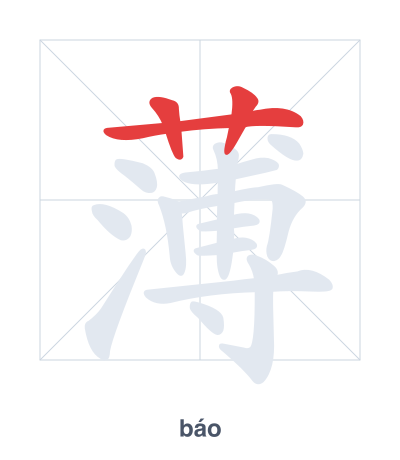
Open Hanzi Writer to see the animated stroke order and practice writing 薄 with real-time feedback.
The character 薄 (báo/bó/bò) is written with 16 strokes. Follow the standard Chinese stroke order: top to bottom, left to right, outside before inside. The radical 艹 is one of its key components.
Practice the correct stroke order with the Hanzi Writer app to see animated stroke-by-stroke guidance with real-time feedback.
薄 means thin; weak; slight.
This is a polyphonic character with readings: báo, bó, bò.
As an HSK Level 4 character, 薄 is an intermediate-level character.
薄 combines the grass radical 艹 with 溥 (pǔ), which originally depicted water spreading thinly. Together they suggest a thin layer of grass or something spread out thinly, leading to meanings like 'thin', 'weak', or 'slight'.
💡 Memory Tip: Picture a thin sheet of grass (艹) spread out so thinly (like 溥's flowing water) that you can almost see through it.
土豆被切成了薄薄的薄片。
tǔ dòu bèi qiè chéng le báo báo de báo piàn
The potatoes were cut into very thin slices.
妈妈烙的薄饼又香又软。
mā mā lào de báo bǐng yòu xiāng yòu ruǎn
The pancakes Mom made are fragrant and soft.
这么冷的天,他只穿了一件单薄的衬衫。
zhè me lěng de tiān tā zhǐ chuān le yī jiàn dān bó de chèn shān
On such a cold day, he is only wearing a thin shirt.
高山上的空气非常稀薄。
gāo shān shàng de kōng qì fēi cháng xī bó
The air on high mountains is very thin.
Open Hanzi Writer to see the animated stroke order and practice writing 薄 with real-time feedback.
✨ Animated stroke order · Handwriting recognition · HSK-graded practice · Free to use
薄 has the radical 艹 (grass) on top, suggesting it originally related to plants or thin layers. The lower part 溥 (pǔ) provides pronunciation and contains the water radical 氵, hinting at something spread thinly like water. Together, they create the idea of something thin, weak, or slight.