脱 (tuō) means "to take off; to shed; to escape" in Chinese. It has 11 strokes with the radical ⺼, and is HSK Level 4.
Rated 4.2/5 in difficulty (advanced).
Harder than 88% of HSK Level 4 characters.
Appears in 3+ common words including 脱衣服 (tuō yī fú), 脱鞋 (tuō xié), 脱发 (tuō fà).
Due to its 11 strokes, Hanzi Writer's error detection shows 脱 requires focused practice — most learners need 10+ attempts for consistent accuracy.
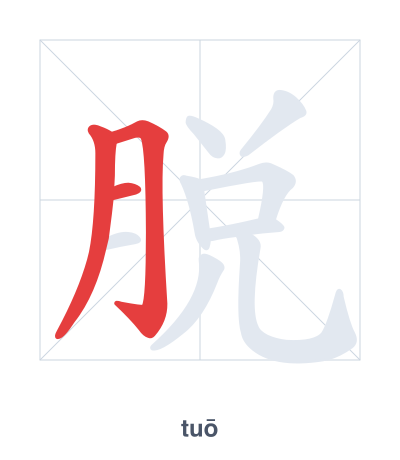
Open Hanzi Writer to see the animated stroke order and practice writing 脱 with real-time feedback.
The character 脱 (tuō) is written with 11 strokes. Follow the standard Chinese stroke order: top to bottom, left to right, outside before inside. The radical ⺼ is one of its key components.
Practice the correct stroke order with the Hanzi Writer app to see animated stroke-by-stroke guidance with real-time feedback.
脱 means to take off; to shed; to escape.
As an HSK Level 4 character, 脱 is an intermediate-level character.
脱 combines ⺼ (meat, flesh) as the radical with 兑 (exchange, convert). The original idea was to remove the flesh or skin from an animal, which evolved into the general sense of taking off or shedding something, and later to escaping or freeing oneself.
💡 Memory Tip: Picture a person using a pair of scissors (兑) to cut away a piece of meat (⺼) from their body, shedding it like old skin.
回家后先脱衣服。
huí jiā hòu xiān tuō yī fú
Take off your clothes first after getting home.
进屋请脱鞋。
jìn wū qǐng tuō xié
Please take off your shoes when entering the house.
他最近有点脱发。
tā zuì jìn yǒu diǎn tuō fà
He has been losing some hair lately.
Open Hanzi Writer to see the animated stroke order and practice writing 脱 with real-time feedback.
✨ Animated stroke order · Handwriting recognition · HSK-graded practice · Free to use
脱 combines the radical ⺼ (flesh/meat) with the phonetic component 兑 (duì). The flesh radical suggests the body, while 兑 hints at the sound and can imply a sense of 'exchanging' or 'removing', together forming the idea of taking something off the body.