讣 (fù) means "obituary; to announce a death" in Chinese. It has 4 strokes with the radical 讠.
Rated 2.4/5 in difficulty (moderate).
Appears in 3+ common words including 讣告 (fù gào), 讣闻 (fù wén), 讣文 (fù wén).
Hanzi Writer's stroke validation shows learners typically need 5-8 attempts to write 讣 with correct proportion and order.
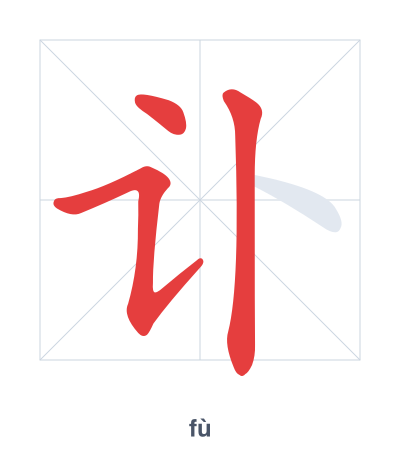
Open Hanzi Writer to see the animated stroke order and practice writing 讣 with real-time feedback.
The character 讣 (fù) is written with 4 strokes. Follow the standard Chinese stroke order: top to bottom, left to right, outside before inside. The radical 讠 is one of its key components.
Practice the correct stroke order with the Hanzi Writer app to see animated stroke-by-stroke guidance with real-time feedback.
讣 means obituary; to announce a death.
The character 讣 combines the speech radical 讠 (words) with 卜 (bǔ), which originally depicted a crack on an oracle bone used for divination—implying a fateful announcement. Together, they mean 'to speak of a death,' as an obituary is a solemn declaration of someone's passing. The traditional form 訃 uses 言 instead of 讠, but the logic remains the same.
💡 Memory Tip: Picture a person speaking (讠) next to a small grave cross (卜) to announce a death.
报纸上有一则讣告。
bào zhǐ shàng yǒu yī zé fù gào
There is an obituary in the newspaper.
我收到了他的讣闻。
wǒ shōu dào le tā de fù wén
I received his obituary.
这篇讣文写得很感人。
zhè piān fù wén xiě dé hěn gǎn rén
This obituary is written very movingly.
Open Hanzi Writer to see the animated stroke order and practice writing 讣 with real-time feedback.
✨ Animated stroke order · Handwriting recognition · HSK-graded practice · Free to use
讣 is composed of the radical 讠, which represents speech or words, on the left, and the component 卜 on the right, which originally meant "to divine" but here hints at a sudden event. Together, the character conveys "words announcing a death" — an obituary or notification of someone's passing.