括 (kuò) means "to include; to enclose" in Chinese. It has 9 strokes with the radical 扌, and is HSK Level 4.
Rated 4/5 in difficulty (challenging).
Harder than 58% of HSK Level 4 characters.
Appears in 3+ common words including 包括 (bāo kuò), 括号 (kuò hào), 概括 (gài kuò).
Due to its 9 strokes, Hanzi Writer's error detection shows 括 requires focused practice — most learners need 10+ attempts for consistent accuracy.
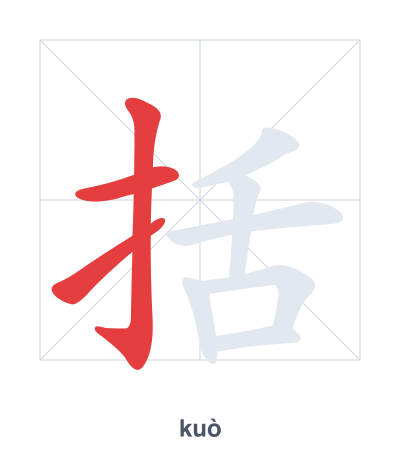
Open Hanzi Writer to see the animated stroke order and practice writing 括 with real-time feedback.
The character 括 (kuò) is written with 9 strokes. Follow the standard Chinese stroke order: top to bottom, left to right, outside before inside. The radical 扌 is one of its key components.
Practice the correct stroke order with the Hanzi Writer app to see animated stroke-by-stroke guidance with real-time feedback.
括 means to include; to enclose.
As an HSK Level 4 character, 括 is an intermediate-level character.
The character 括 combines the hand radical 扌 (action) with 舌 (tongue) as a phonetic component. The original meaning was 'to bind or wrap' with one's hand, later extending to 'include' or 'enclose.'
💡 Memory Tip: Imagine your hand (扌) clamping over your tongue (舌) to enclose a secret inside your mouth.
费用包括午餐。
fèi yòng bāo kuò wǔ cān
The fee includes lunch.
请在括号内填空。
qǐng zài kuò hào nèi tián kòng
Please fill in the blanks in the parentheses.
请概括一下大意。
qǐng gài kuò yī xià dà yì
Please summarize the main idea.
Open Hanzi Writer to see the animated stroke order and practice writing 括 with real-time feedback.
✨ Animated stroke order · Handwriting recognition · HSK-graded practice · Free to use
The character 括 has two parts: the left radical 扌 (hand) and the right part 舌 (tongue). Together they suggest the hand performing an action related to the tongue, which evolved to mean "to include" or "to enclose"—like using a hand to wrap something up.