讨 (tǎo) means "To demand or discuss" in Chinese. It has 5 strokes with the radical 讠, and is HSK Level 2.
Rated 2.2/5 in difficulty (moderate).
Harder than 13% of HSK Level 2 characters.
Appears in 3+ common words including 讨论 (tǎo lùn), 讨厌 (tǎo yàn), 讨价 (tǎo jià).
Hanzi Writer's stroke validation shows learners typically need 5-8 attempts to write 讨 with correct proportion and order.
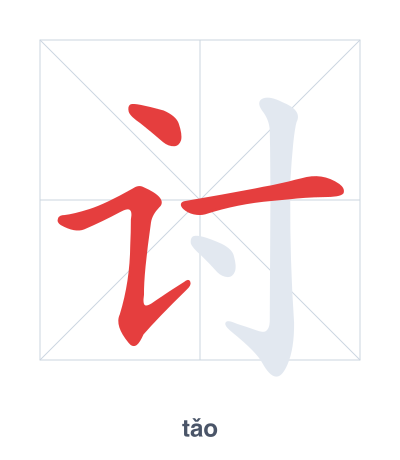
Open Hanzi Writer to see the animated stroke order and practice writing 讨 with real-time feedback.
The character 讨 (tǎo) is written with 5 strokes. Follow the standard Chinese stroke order: top to bottom, left to right, outside before inside. The radical 讠 is one of its key components.
Practice the correct stroke order with the Hanzi Writer app to see animated stroke-by-stroke guidance with real-time feedback.
讨 means To demand or discuss.
As an HSK Level 2 character, 讨 is among the first characters beginners learn.
讨 combines the speech radical 讠 (words) with 寸 (a hand or measure), originally suggesting using words to demand or discuss something, like pressing a point with measured speech.
💡 Memory Tip: Imagine someone using their hand (寸) to grab your words (讠) and demand you discuss further.
我们正在讨论问题。
wǒ men zhèng zài tǎo lùn wèn tí
We are discussing the issue.
我很讨厌下雨天。
wǒ hěn tǎo yàn xià yǔ tiān
I really hate rainy days.
买东西可以讨价还价。
mǎi dōng xī kě yǐ tǎo jià huán jià
You can bargain when buying things.
Open Hanzi Writer to see the animated stroke order and practice writing 讨 with real-time feedback.
✨ Animated stroke order · Handwriting recognition · HSK-graded practice · Free to use
讨 is made of the radical 讠 (speech) on the left and 寸 (inch, a unit of measure) on the right. The speech radical connects to the meaning of discussing or demanding, while 寸 suggests taking a measured amount or action, together creating the idea of 'to demand or discuss something in a measured way.'