偎 (wēi) means "to lean close to; to cuddle" in Chinese. It has 11 strokes with the radical 亻.
Rated 3.9/5 in difficulty (challenging).
Appears in 3+ common words including 依偎 (yī wēi), 偎依 (wēi yī), 偎着 (wēi zhe).
Due to its 11 strokes, Hanzi Writer's error detection shows 偎 requires focused practice — most learners need 10+ attempts for consistent accuracy.
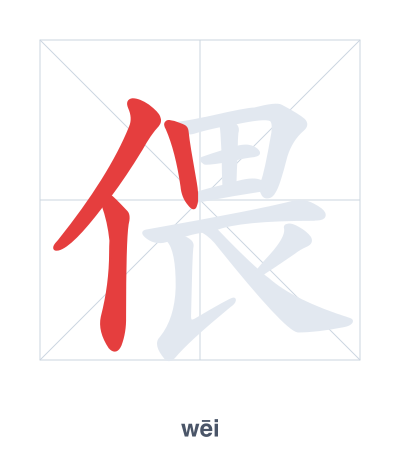
Open Hanzi Writer to see the animated stroke order and practice writing 偎 with real-time feedback.
The character 偎 (wēi) is written with 11 strokes. Follow the standard Chinese stroke order: top to bottom, left to right, outside before inside. The radical 亻 is one of its key components.
Practice the correct stroke order with the Hanzi Writer app to see animated stroke-by-stroke guidance with real-time feedback.
偎 means to lean close to; to cuddle.
偎 is a phono-semantic compound: the radical 亻 (person) indicates a human action, while 畏 (wèi, 'to fear') provides the sound and suggests the idea of seeking comfort from fear—hence 'to lean close' or 'cuddle' for reassurance.
💡 Memory Tip: Imagine a person (亻) cuddling their fearful friend (畏) to make them feel safe.
小猫依偎在沙发上。
xiǎo māo yī wēi zài shā fā shàng
The kitten snuggled on the sofa.
他们互相偎依着。
tā men hù xiāng wēi yī zhe
They are snuggling up to each other.
孩子偎着妈妈睡觉。
hái zi wēi zhe mā mā shuì jiào
The child is sleeping snuggled up to their mother.
Open Hanzi Writer to see the animated stroke order and practice writing 偎 with real-time feedback.
✨ Animated stroke order · Handwriting recognition · HSK-graded practice · Free to use
偎 is made of two parts: the radical 亻 (person) on the left, and the phonetic component 畏 (wèi) on the right. The person radical shows that the action involves a human, while 畏 gives the sound. Together they form a word meaning "to lean close to" or "cuddle," which is a human action of intimate closeness.