认 (rèn) means "to recognize; to admit" in Chinese. It has 4 strokes with the radical 讠, and is HSK Level 1.
Rated 1.9/5 in difficulty (beginner-friendly).
Harder than 18% of HSK Level 1 characters.
Appears in 3+ common words including 认识 (rèn shí), 认真 (rèn zhēn), 认为 (rèn wéi).
In the Hanzi Writer app, most learners master 认 within 3 practice attempts using stroke-by-stroke animation.
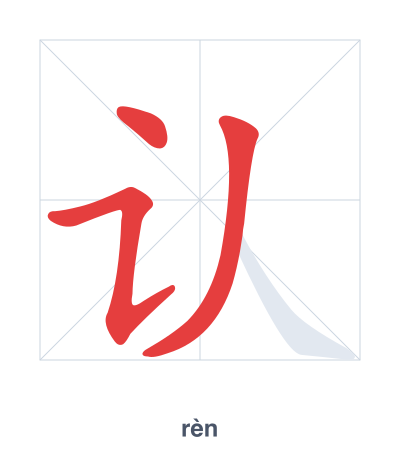
Open Hanzi Writer to see the animated stroke order and practice writing 认 with real-time feedback.
The character 认 (rèn) is written with 4 strokes. Follow the standard Chinese stroke order: top to bottom, left to right, outside before inside. The radical 讠 is one of its key components.
Practice the correct stroke order with the Hanzi Writer app to see animated stroke-by-stroke guidance with real-time feedback.
认 means to recognize; to admit.
As an HSK Level 1 character, 认 is among the first characters beginners learn.
认 is a simplified compound of 認, which combined 言 (speech) and 忍 (to endure/recognize). In the simplified form, 讠 (speech) plus 人 (person) suggests 'a person speaking'—to recognize someone by voice or to verbally admit something.
💡 Memory Tip: Imagine a person (人) speaking (讠) to you, and you nod to show you recognize or admit what they said.
我认识那个新同学。
wǒ rèn shí nà ge xīn tóng xué
I know that new classmate.
他学习非常认真。
tā xué xí fēi cháng rèn zhēn
He studies very seriously.
我认为这个主意很好。
wǒ rèn wéi zhè ge zhǔ yì hěn hǎo
I think this idea is very good.
Open Hanzi Writer to see the animated stroke order and practice writing 认 with real-time feedback.
✨ Animated stroke order · Handwriting recognition · HSK-graded practice · Free to use
认 is made of the speech radical 讠 on the left and the person radical 人 on the right. The speech part suggests language or speaking, while the person part points to identifying someone. Together, they represent the idea of recognizing or acknowledging a person through words.