做 (zuò) means "to do; to make; to become" in Chinese. It has 11 strokes with the radical 亻, and is HSK Level 1.
Rated 3.4/5 in difficulty (challenging).
Harder than 72% of HSK Level 1 characters.
Appears in 3+ common words including 做饭 (zuò fàn), 做作业 (zuò zuò yè), 做事 (zuò shì).
Due to its 11 strokes, Hanzi Writer's error detection shows 做 requires focused practice — most learners need 10+ attempts for consistent accuracy.
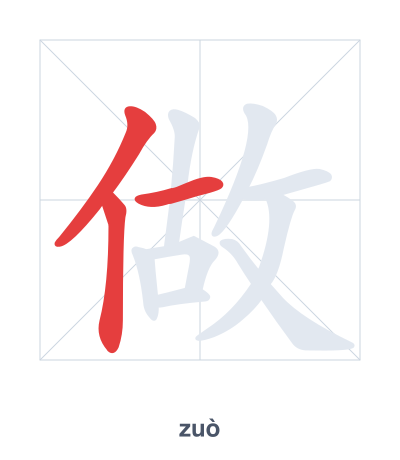
Open Hanzi Writer to see the animated stroke order and practice writing 做 with real-time feedback.
The character 做 (zuò) is written with 11 strokes. Follow the standard Chinese stroke order: top to bottom, left to right, outside before inside. The radical 亻 is one of its key components.
Practice the correct stroke order with the Hanzi Writer app to see animated stroke-by-stroke guidance with real-time feedback.
做 means to do; to make; to become.
As an HSK Level 1 character, 做 is among the first characters beginners learn.
做 combines the person radical 亻 with 故 (meaning 'cause' or 'old'), suggesting a person taking deliberate action based on a reason. The right side 故 itself contains 古 (ancient) and 攵 (a hand with a stick), hinting at the effort and time involved in making or doing something.
💡 Memory Tip: Imagine a person (亻) making an ancient (古) artifact by striking it with a hand (攵) — that's how you 'do' or 'make' something.
我喜欢在家里做饭。
wǒ xǐ huān zài jiā lǐ zuò fàn
I like cooking at home.
他在房间里做作业。
tā zài fáng jiān lǐ zuò zuò yè
He is doing homework in the room.
他做事很认真。
tā zuò shì hěn rèn zhēn
He is very serious and conscientious about his work.
Open Hanzi Writer to see the animated stroke order and practice writing 做 with real-time feedback.
✨ Animated stroke order · Handwriting recognition · HSK-graded practice · Free to use
做 is composed of the radical 亻 (person) on the left and the component 故 on the right, which combines 古 (old) and 攵 (action). Together, they suggest a person taking action or creating something, relating to the meanings 'to do', 'to make', and 'to become'.