偕 (xié) means "together; along with" in Chinese. It has 11 strokes with the radical 亻.
Rated 3.9/5 in difficulty (challenging).
Appears in 3+ common words including 偕同 (xié tóng), 白头偕老 (bái tóu xié lǎo), 偕行 (xié xíng).
Due to its 11 strokes, Hanzi Writer's error detection shows 偕 requires focused practice — most learners need 10+ attempts for consistent accuracy.
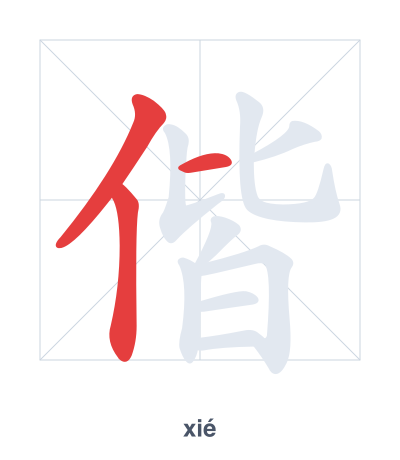
Open Hanzi Writer to see the animated stroke order and practice writing 偕 with real-time feedback.
The character 偕 (xié) is written with 11 strokes. Follow the standard Chinese stroke order: top to bottom, left to right, outside before inside. The radical 亻 is one of its key components.
Practice the correct stroke order with the Hanzi Writer app to see animated stroke-by-stroke guidance with real-time feedback.
偕 means together; along with.
偕 is a phono-semantic compound: the radical 亻 (person) indicates relation to people, and the component 皆 (jiē) meaning 'all, together' contributes the sound and suggests the idea of everyone together, thus conveying 'together with' or 'along with'.
💡 Memory Tip: Imagine a person (亻) joining a group where everyone (皆) is holding hands to walk together in harmony.
他偕同好友去旅游。
tā xié tóng hào yǒu qù lǚ yóu
He went traveling with his good friend.
祝你们白头偕老。
zhù nǐ men bái tóu xié lǎo
Wish you a long life together.
两人偕行在小路上。
liǎng rén xié xíng zài xiǎo lù shàng
The two are walking together on the path.
Open Hanzi Writer to see the animated stroke order and practice writing 偕 with real-time feedback.
✨ Animated stroke order · Handwriting recognition · HSK-graded practice · Free to use
The character 偕 consists of the radical 亻 (person) on the left and the component 皆 (all, every) on the right. The person radical indicates an action done by people, and 皆 adds the idea of "all together," so 偕 means "together with" or "accompanied by."