让 (ràng) means "To let, allow, or yield" in Chinese. It has 5 strokes with the radical 讠, and is HSK Level 2.
Rated 2.2/5 in difficulty (moderate).
Harder than 13% of HSK Level 2 characters.
Appears in 3+ common words including 让座 (ràng zuò), 让步 (ràng bù), 让开 (ràng kāi).
Hanzi Writer's stroke validation shows learners typically need 5-8 attempts to write 让 with correct proportion and order.
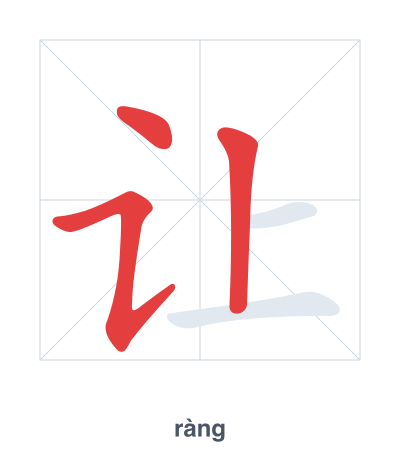
Open Hanzi Writer to see the animated stroke order and practice writing 让 with real-time feedback.
The character 让 (ràng) is written with 5 strokes. Follow the standard Chinese stroke order: top to bottom, left to right, outside before inside. The radical 讠 is one of its key components.
Practice the correct stroke order with the Hanzi Writer app to see animated stroke-by-stroke guidance with real-time feedback.
让 means To let, allow, or yield.
As an HSK Level 2 character, 让 is among the first characters beginners learn.
The character 让 combines the radical 讠 (speech) with 上 (shàng, 'above' or 'up'). The idea is that in speech, you yield the floor or let others go 'above' you — thus 'to let, allow, or yield.'
💡 Memory Tip: Picture a person saying '上' (up) while gesturing for someone else to go first, showing they are letting them pass.
请给老人让座。
qǐng gěi lǎo rén ràng zuò
Please give up your seat to the elderly.
他最后做出了让步。
tā zuì hòu zuò chū le ràng bù
He finally made a concession.
请让开一下。
qǐng ràng kāi yī xià
Please step aside.
Open Hanzi Writer to see the animated stroke order and practice writing 让 with real-time feedback.
✨ Animated stroke order · Handwriting recognition · HSK-graded practice · Free to use
The character 让 is composed of two parts: the radical 讠 on the left, which represents speech or language, and the component 上 (shàng, meaning 'up' or 'above') on the right. Together, they suggest the idea of using words to allow someone to go ahead or yield, which connects to the meanings 'to let,' 'allow,' or 'yield.'