阿 (ā/ē) means "prefix for names; ah" in Chinese. It has 7 strokes with the radical 阝, and is HSK Level 4.
Rated 3.2/5 in difficulty (challenging).
Harder than 24% of HSK Level 4 characters.
Appears in 4+ common words including 阿姨 (ā yí), 阿爸 (ā bà), 阿谀 (ē yú).
Due to its 7 strokes, Hanzi Writer's error detection shows 阿 requires focused practice — most learners need 10+ attempts for consistent accuracy.
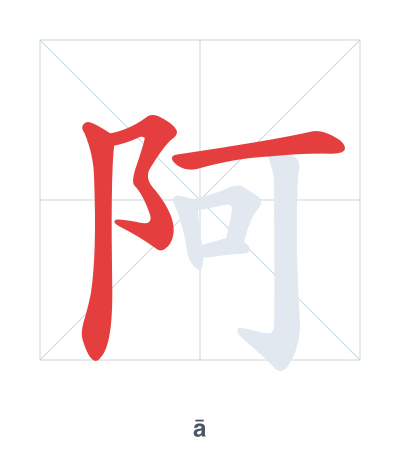
Open Hanzi Writer to see the animated stroke order and practice writing 阿 with real-time feedback.
The character 阿 (ā/ē) is written with 7 strokes. Follow the standard Chinese stroke order: top to bottom, left to right, outside before inside. The radical 阝 is one of its key components.
Practice the correct stroke order with the Hanzi Writer app to see animated stroke-by-stroke guidance with real-time feedback.
阿 means prefix for names; ah.
This is a polyphonic character with readings: ā, ē.
As an HSK Level 4 character, 阿 is an intermediate-level character.
阿 is a phono-semantic compound combining the radical 阝 (mound/hill) with the phonetic component 可 (kě). Its original meaning was a large slope or riverbank, which later extended to serve as a prefix for names (like 阿爸) and an exclamation 'ah.'
💡 Memory Tip: Picture a hill (阝) where someone stands at the top, arms raised, shouting 'Ah!' as the right side 可 suggests a person with outstretched limbs.
邻居家的阿姨性格很开朗。
lín jū jiā de ā yí xìng gé hěn kāi lǎng
The aunt next door has a very cheerful personality.
他的阿爸在草原上放牧。
tā de ā bà zài cǎo yuán shàng fàng mù
His father is herding livestock on the grasslands.
真正有才干的人不需要阿谀奉承。
zhēn zhèng yǒu cái gàn de rén bù xū yào ē yú fèng chéng
Truly talented people do not need flattery.
这种阿胶具有很好的滋补作用。
zhè zhǒng ē jiāo jù yǒu hěn hǎo de zī bǔ zuò yòng
This donkey-hide gelatin has a good nourishing effect.
Open Hanzi Writer to see the animated stroke order and practice writing 阿 with real-time feedback.
✨ Animated stroke order · Handwriting recognition · HSK-graded practice · Free to use
阿 is made of two parts: the left radical 阝 (meaning "mound" or "hill") and the right part 可 (kě), which provides the sound. Originally 阿 referred to a large hill or slope, but today it is used as a prefix for names or as an exclamation, and the hill meaning is no longer common.